Monday, 30 June 2008

A weekend miscellany

(Click on photos to enlarge)


I thought I would sort out some photos of what was going on yesterday, from wine-making to Car Boot Sale booty.

The big heavy horse shoe I found in the stream by Lime Kiln Field this week. It would have been made by the blacksmith who lived at the bottom of our hill.

The lovely butter mould I got at the Car Boot Sale yesterday for just £3. It is French (has 225 grams written in a lovely Copperplate on the bottom), and I intend to give it a good wash and use it.

This shows how it opens up to release the butter pat.

Plants waiting to be planted - Penstemon, Geum, Phygelus (?), Verbascum, etc.

A double lot of Elderflower Champagne.

My Sloe wine - I'm trying to empty the freezer a little bit. I shall put it in the demijohn this week.

This is an excellent craft book I picked up for £1 at the Car Boot Sale yesterday. It has information about hundreds of crafts - sufficient to get you started anyway. It might be way out of date on the designs, but the practical side is still relevent.

Here's the excellent book I bought at the Centre for Alternative Technology on Friday. I am looking forward to trying out some of the recipes and techniques.

Saturday, 28 June 2008

Mini meme

(Click to enlarge) On the way to Machynlleth yesterday:


Nancy has tagged me for this, so here we go:

  • Where I was 10 years ago:… here, in Carmarthenshire, still doing up our rambling old farmhouse. My mum had moved in with us two years earlier; I had lots of poultry and was in the 2nd year of my Archaeology degree at Lampeter University.

  • 5 things on my to-do list today: Try to stay awake past teatime!; make a final batch of Elderflower Champagne; do the veg to go with our evening meal (the other half of Friday's Lamb Cobbler); take Itsy-pony out for a walk; do some weeding in the veg. plot.

  • Snack Food I like: oh dear - CRISPS; Peanuts; yoghurt-covered blueberries.

  • If I were a billionaire I would: Help several friends of mine who have struggled in life and deserve some luck; give a large amount to Lluest Horse & Pony Trust to support them for life; set up trust funds for our children; buy a farmhouse in the middle of Dartmoor for me and a Bastle on Hadrian's Wall which is my husband's dream home!

  • Places I have Lived: Hampshire; Dorset; Carmarthenshire.
I won't tag anyone, but if you want to join in, feel free.

Trip to the Centre for Alternative Technology

(Click on photos to enlarge)

The start of our journey. This vernicular railway is run on the weight of water held in tanks beneath the cabin. The full cabin comes down and lifts the empty one to the top. There's one like this at Scarborough and Lynton/Lynmouth too .


This is where my husband and I (always feel like the Queen when I say that!) went yesterday. We first went 10+ years ago for a birthday treat of mine. Sadly, the weather was abysmally wet all the time we were there, we were stunned by the cost of £8.40 each to get in (less £1 for OH as he's now old enough to be a "concession"), and rather disappointed that it was virtually exactly the same as I remember it being 10+ years ago, except the gift shop is now in a new building. We went looking for answers to alternative technology questions, for which only one box was ticked. To be honest, we would have had to part with some serious money on books covering this, that and the other and still at the end of it, not know how long new technologies last before needing replacing, how much it costs to set up for a house this size etc, though we are pretty certain the cost is incredibly prohibitive still. We obviously set out with the wrong set of questions to answer, particularly in the way of the self-reliant approach to alternative technology. Ah well, I enjoyed the gardening side of things and yearn for a polytunnel even more now, and I did get an excellent book on "Preserving Food without Freezing or Canning" and a couple of useful leaflets (watch this space).

Another major grumble was the amount of water on the paths. Where they were so well-worn, huge pools of water formed, making entrance to some of the buildings difficult (some we just abandoned) and even the ladies' loo was almost beyond reach (I had to teeter on the side of the pathway). With that amount of admission, and it being set in a quarry, I am sure they could afford a bit more in the way of chippings down for a dry walkway. We had sensible shoes on, but needed wellies!

I love the grass roof on this little stone cottage and it gives such inspiration as to how much can be packed into a tiny yard.

A close-up of pots, bowls and buckets of plants.

Inside the Geodesic Dome. It was lovely and warm and all you could hear was water from the little water features inside it. Magic.

A view at the other side of the dome.

Inside a HUGE polytunnel. Now THIS is what you call a raised bed!

Inside the same polytunnel - a Fig tree was growing delightedly.

This seat is made from various offcuts of wood, and the gaps in the back had money (mostly coppers) glued into the slits.
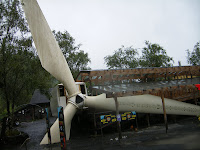
Just to give you an idea of the relative size of the blades of a wind turbine. We have them on many Welsh hills, and I would welcome them if only they were energy efficient, but they run at an average of about 30% productivity and so always have to be backed up by the National Grid, which means in fuel terms, they contribute very little.

This little plot had so many plants crammed into it and was just breathtaking. I am now very tempted to widen my main border(s)! I had no complaints about the growing side of things, and got lots of ideas just from looking, but the energy side was dull . . . sorry guys. Perhaps all the new buildings going up are the answer to my questions and I have just arrived a year or so too soon . . .

Friday, 27 June 2008

Cottage Economy – rush lights

(Click on photo to enlarge).

The thin "needles" behind the Foxglove are the Common Rush (just in case you were imaging a bullrush being used).


I have a feeling we may have power cuts this winter – either through strikes or through the ageing power stations, over which the Government chooses to bury its head in the sand. I have always had a stock of candles in, as did my mother and I have stocked up on matches too, as we need these to light the wood burner.

In the past, cottage folk often relied on rush lights. The little rush light holders, probably made by the village blacksmith and now desirable antiques, fetch a figure which most cottagers would never have earned even in their entire lifetime.

The time for making rush lights was the autumn, when the rush had achieved full growth, but before the outer casing had become tough. Here in Wales, this was normally around the time of the full harvest moon. Cottagers might traipse some distance to find the best rushes to cut, which were then gathered and tied into large sheaves. The rushes were allowed to wither and dry for a time, before being peeled and trimmed to about a foot in length. As children, in Hampshire, we instinctively did this ourselves, using our thumbnail to split the rush and then removing the sponge-like stem.

The rush lights would be made during the family’s “leisure” time, and in Breconshire, some families would have special get-togethers to pabwyra (peel rushes), and there was an old tune, Hyd y frwynen (lit. ‘the length of the rush’) they would sing whilst thus employed. The peeled rushes would be tied in small bundles until there was sufficient number to prepare them as lights, by dipping them into molten wax and placed on a cool slate slab to harden. I have heard of them being dipped in sheep fat, which must have resulted in a very smoky and pungent atmosphere when burned. A rush candle would burn for some 20 minutes and it was not uncommon, in this time before clocks, to set the hour for bed on a winter’s night after the burning of a certain number of candles.


(Notes taken from "The Customs and Traditions of Wales" by Trefor M Owen).


Wednesday, 25 June 2008

Another lovely evening walk

(Click on photos to enlarge)


First thing this morning, even before breakfast, I decided I would tidy my dry store kitchen cupboard, as it was in a mess and I couldn't find anything. It didn't take anything long as I expected, and I put the opened bags of this and that in glass containers where they fitted, and stuff like cous-cous and beans, in the old earthenware containers I bought at auction when we were still in Dorset. We used to buy the cork stoppers in a little winemaking shop in Blandford. They were my sole storage containers for many years. You can see one on the 2nd shelf down. It was a job well done - and long overdue doing too!


Here's another job which had been calling me for a loooooooong while. My rockery. Except it was barely recognisable as a rockery, as it was overgrown, full of bits of broken dead rose-twigs and leaves, and the only plants in it were wild Umbellifers! An afternoon's work and some fresh rockery plants have transformed it, though there's still some tidying up needed right at the back.


I made some bread dough earlier, and whilst it was proving, I had a lovely walk up our hill again. I was out for nearly an hour, though I had only planned to walk to the top of the hill and back. It is such a lovely evening that I kept on walking though, and cut back across the fields.


A view I never tire of - looking East towards Black Mountain (the last of the Carmarthen Fans, which we climbed recently).


Looking towards the Towy Valley.


A neighbouring farmhouse, an old early Georgian house with a Norman motte and bailey behind it. The Normans would have doubtless used it as a hunting lodge a thousand years ago.

My friend the bat-eared cow again, back on her way to the field after milking.

Tuesday, 24 June 2008

A walk to the pond

(Click on photos to enlarge)

I felt a need to get away last night, so I walked down the farm track and went and sat by the pond. It is a man-made one, excavated by the farmer for the chaps who have the shoot on his land (though I dare say there must have been a grant to to it in the first place, or he wouldn't have bothered). It was so beautiful and peaceful - just the sound of Coots and Moorhens in the reeds, though I couldn't see them. A Heron rose up out of the water as I approached. I sat on a log and meditated and took LOTS of photos. Here are just a few.

Foxgloves were almost luminescent against the setting sun.

Looking across the valley. On the top of the hill above the gorse you may just be able to see the banks of the old Iron Age hillfort.

Thistle and I think, Water Dropwort, by a small stream.

The pond was so peaceful.

More foxgloves and spagnum moss.

Looking up the valley across the pond.

A view in the opposite direction.

Walking home, the cows had been milked and were grazing the lengthening shadows.

Monday, 23 June 2008

The Cornish Gook or Gouch

(Click on photo to enlarge)


I was absolutely fascinated by the bonnets the Cornish dancers wore, and sought them out after they had paraded, to find out more about them. I had never heard of a Gook (or Gouch) before. I had never considered, for instance, that each Parish might have a different pattern to distinguish it from others, and don't know whether this happened throughout rural areas, that these traditional bonnets (worn by agricultural and outdoor workers across the country) might have such individuality.

I had noticed them being worn in old photographs, and in period dramas (think especially Tess of the D'Urbervilles here!) and always thought I would quite like to make one - much as I would like to make a traditional smock too, but I have always been a dreamer! Anyway, here is a link to a site which explains more fully about the Gook (though it is essentially a family history site - and a very interesting one at that): http://gwennap-opc.tripod.com/gouch.htm


The Cornish dancers kindly posed for their photographs and told me everything they knew about the Gooks.

Side view of one pattern.

Side view of the other pattern.


View from behind.

Now which one shall I try and make during the grey miserable days of winter?

Old Celtic Customs

This morning it suddenly occurred to me there have been several things recently I wanted to blog about, but then I got busy and they escaped my mind. So today will be catch-up time.

The folk dancers parading in the ring at Builth.


Last month I went to the Smallholders' Show at Builth Wells, and posted some photos of Cornish and Welsh folk dancers and "characters". There was a very splended Mari Llwd (roughly translated grey mare or grey Mary) Anyway, the Mari Llwd is a horse's skull, which used to be paraded from door to door at New Year. The skull was beribboned, covered with a white sheet, and carried by a man beneath the sheet who would operate the jaw and make it snap. A party of people, "who included Sergeant, Merryman, Punch and Judy would engage in poetic contest, singing as many as fifteen verses before they were eventually allowed to enter." Then the Mari would enter the house and begin chasing all the girls like a wild thing, snapping at them with its jaws. Food and drink were then offered. It is believed that this tradition was connected with Wassailing.

Anyway, at the Smallholders' Show there was a superb Mari Llwd who paraded through the showground and into the main ring with its handlers. I feel it is so vital to keep the tradition alive - and the handlers dressed SO well for their parts!

Sunday, 22 June 2008

Baking

If you're wondering what I was up to last week when I was too busy to blog, here are three of the cakes I made for the wedding of an acquaintance.


First, one of two Carrot cakes (with crushed pineapple in) - this one has a cream cheese icing. I left the other one plain.

This is one of two chocolate cakes - this one topped with choc. butter icing, a crumbled Flake bar and After Eight mints.


The one my son will never forgive me for not having ever made for US at home (something I must remedy. Stuffed with double cream and strawberries, and topped with double cream, and a crumbled Flake bar. Yum!

I ended up making, apart from the above: a Coffee cake (the first and last I shall EVER make!); about 45 plain scones (together with home-made strawberry jam and extra thick double cream for the filling at table); 25 pear scones; 45 iced and sprinkled fancy buns; a dozen Last Rollo chocolate buns; a dozen white chocolate and walnut muffins; 30 jam tarts (home-made jam); a tray bake of chocolate blackberry brownies; 30 apricot and coconut balls; and 2 Lemon Drizzle cakes. I think that’s it. Oh and two pots of home-made strawberry jam. I’m all baked out, and will never be QUITE so rash ever again!

Saturday, 21 June 2008

Back to the future and making do . . .

Home made crab apple wine which I bottled recently.


I am mindful of the title of this posting, as several times in recent days I have had to rethink the ingrained habits of a lifetime!

The first occasion was when my blender broke. In fact, I had a fey moment as I was carrying it across the kitchen, as I thought, gosh I'd be stuck for making caster sugar (I always blend the granulated which saves the premium on buying caster sugar) if anything happened to this. Then it did - I plugged it into the adaptor (which was of course live), caught the pulse button with my arm as I leaned across, there was one hell of a rattle and bang, no more blender! I had foolishly not noticed that the little plug for the lid was by the blades, the pulse had jammed it in and when I took the jug off the blender to sort it, it had sheared off . . . My instant reaction was oh bloddy hell . . . Then I had to make my brain do some work and came up with the idea of reducing the sugar by hand with my pestle and mortar, which worked a treat. Fortunately the sugar was already quite a fine one - not like the great big granules I remember from childhood sugar in the blue sugar-paper bags.

Then yesterday I decided that my well-used pastry brush for greasing pans had really reached the end of the line. The new one I had was shedding hairs like it was moulting. I cast my mind back 40 years and reached for a butter wrapper. I can remember being told to save these at school, put them in a tin, and then you could use the very last little bits of butter on it to grease tins (hmmm - probably rancid by then!) Anyway, I had to unwrap a new slab of butter anyway, so . . . problem solved. Then I needed to brush milk on top of scones - I used the back of a spoon, which actually worked very well. I don't think I shall be reaching for that Lake District catalogue just yet . . .

With all the price rises in fuel and food recently, we have been adapting, and adding to our store cupboard too. It pays to buy in bulk (flour, rice etc) and it also pays to buy extra because the price will have almost certainly gone up in a month - if not a week. My husband is going to build me a pantry in the room which was a sort of utility down in what was my mum's flat. This "room" is built into the side of the hill, so below the main part of the house, a bit like an undercroft. It is always cool, and has a quarry tiled floor. Currently we have two old fridges sitting there, switched off, and a small freezer. We are loathe to get rid of the fridges as although they are probably 50 or more years old, they are so efficient that they will freeze cucumbers rigid and do the same for milk too. They have excellent insulation. The one which was my mum's was converted from gas by my dad, when it was traded into the family shop in Romsey, back in the early 60s. Anyway, my husband is going to put up a slate shelf above these fridges - in fact, we even have the length of slate slab leaning against the front of the house as we were going to use it as a replacement worktop, but it is not quite long enough. It cost us just £10 at auction a couple of years ago, along with another shorter piece which will also get utilised. Then I will be able to store home made bottled stuff, preserves, wine etc, and use the slab for keeping cheese, butter, etc cool. Handy if we get the power cuts they are threatening in future because of the tardiness of the Govt. in replacing ageing power stations. We will have sturdy wooden shelves for storage on the wall above the shelf. I'm really excited about this (like a big kid I am!)

This week I have put some Sloes in the wine bucket, and hope to make another lot of Elderflower Champagne too, and some Elderflower wine as well. No peace for the wicked.

Thursday, 19 June 2008

It's a misty moisty morning here . . .

I have a busy day ahead again - would have more hours in it but I have just spent 3/4 of an hour "trying" to load this morning's photos on here. Oh for a decent broadband connection and not just 0.5 mg of "oomph" . . .

I grabbed the camera just in time to catch the sun breaking through the mist and clouds before 6 a.m. this morning. This is looking East (obviously!) over the farm buildings next door. Very atmospheric.


Here is the pine tree which is my weathervane for winds. In a gale, it will twist and thrash like a soul in torment. This morning it is calm and watchful.


A slightly longer view, showing the farm track and the other trees (oaks and sycamores) which keep the pine company.

The cows coming up for milking. The delightful ping-pong-bat-eared individual at the front is a Brown Swiss.

One of my ramblers, nearly twenty years old now. It has a French name which currently escapes me.

Its next door neighbour, a pretty orange-scented rambler called The Garland.

An unwanted guest - normally Welsh slugs are the size of small Corgis, but this one is a baby, with a very poor sense of direction . . .


Wednesday, 18 June 2008

History of Carew Castle

Click on photo to enlarge.


This will have to be a brief, potted history as I have a list of things to do today a mile long!

Its position on the side of the river (a tidal creek) is due partly to a strategic ridge of higher ground and partly to it being near a part of the river where it was fordable at low tide (there is now a causeway stretching across the river from the tidal mill in fact. I intend to walk that "next time".

Legend has it that Carew was founded by Gerald of Windsor, Constable of Pembroke Castle. He married Nest, who was a daughter of Rhys ap Tewdwr. (Think anglicised "Tudor" here . . .) She was the grandmother of Giraldus Cambrensis, father of Welsh history. The original castle has long since disappeared and the medieval parts of the remaining castle date to around 1280 - 1310, built for Sir Nicholas de Carew. His grandson sold Carew to Sir Rhys ap Thomas, a warrior Lord who joined Henry of Richmond (Harri Tudur) when he landed at nearby Dale, and accompanied him to the Battle of Bosworth (1485) where Harri Tudur defeated Richard III and himself became Henry VII, first of the Tudor monarchs. Our own house played a part in this history, because the Griffiths, who lived here then (and were High Sheriffs of Carmarthen in the early Elizabethan period) sent a son to be Esquire to the Body of Henry VII. Friends in high places springs to mind . . .

There was a grand tournament at Carew in 1507, in celebration of the Tudors, but Sir Rhys's grandson was beheaded 25 years later and the castle seized by Henry VIII. The grand new wing with the enormous windows was built by Sir John Perrott in the 16th C, who had aquired it by that time, but he too fell from favour and was imprisoned in the Tower of London, where he died before he was beheaded.

Local legend tells a bizarre story of Sir Roland Rhys, tenant of the castle in Jacobean times, setting his tame ape on a local Flemish merchant because his daughter had eloped with Roland's son. However, the ape later attacked his owner, and the castle set on fire! During the Civil War damage was caused when attacking forces dug a mineshaft under one side of the castle.

Many thanks to "Castles in Wales" a book which has been well-thumbed during our years here.

Monday, 16 June 2008

Carew Castle

(Click on photos to enlarge)


I will have to do posts on Carew Cross and Carew Tide Mill seperately, as there are too many photos to load otherwise. My son and I visited the castle a couple of weeks ago, after doing a Car Boot Sale down that way. Whenever I'd been there before, it was always shut.

I have got the photos all hodge-podge I'm afraid, but I hope they make some sense. I will find a potted history later on.


Bats are free to flit where once fine gentlemen strolled and ladies sat with their needlework.

During the Elizabethan period, an extension was added, with such huge light windows on all sides that the rooms must have been as bright as the day outside.

This is the Undercroft, which wasn't actually as gloomy as it appears in the photograph.

A beautiful stained glass window (a modern one of course). The lady on the left is Nest, and the Lord is lord of Carew of course.

An outside view of the Elizabethan "extension" with its fine windows still well-preserved.

The gatehouse into the inner part of the castle.

The view as you approach, showing how close to the river the Castle is.

Sunday, 15 June 2008

A Curious Case . . .

This is Carew Castle, which I visited recently with my son. (Click to enlarge). I'll try and write about it tomorrow.
I bought a little book called "What the Countryman Wants to Know" recently. It was published in 1948. There are lots of interesting facts about birds, and a few at the end about insects and butterflies.

"During the World War which began in 1939, an unusual incident occurred at Crookes, Sheffield. The occupants of a house, upon entering the yard after dark, thought, at first, that an incendiary bomb had fallen there, for one corner was brilliantly illuminated. Investigation showed that the light was caused by glow-worms. The insects reappeared at the same place on the following night: but were not seen again afterwards. The premises are in the vicinity of waste land and allotments."

I've only seen glow-worms once, along a stretch of the long-abandoned (thanks to Dr Beeching) S&D railway (Somerset and Dorset) near Sturminster Marshall. They were quite magical. I don't think we have them in this neck of the woods - but then, I've never gone out looking!

Friday, 13 June 2008

Elderflowers and a hotch-potch of photos

This week I have been Doing Things with Elderflowers. We have two big bushes at the bottom of the yard, so I don't have to go far to pick them. I made some Elderflower Champagne first, which I shall strain and bottle today, and then yesterday afternoon I made some Elderflower handcream. It is brilliant when you have gardener's hands, or get those awful deep splits on your fingers when it gets really cold in the depths of winter. Today it will be some Elderflower Wine getting started off, and I hope to make some Syrup too.

The handcream-cum-salve is very simple to make. Take a 500g (1lb) block of lard - or whatever base you may choose to use. Melt is in a large pan and place in the fat as many elderflower heads as you can immerse. Make sure that they are FRESHLY opened flowers and not the slightly yellowing ones which have been open a few days, as they will pong like tomcats! Heat on the lowest of low heats for about 30 - 40 mins. The flowers will turn brown, but it should not sizzle. Turn off heat, and remove the flowers with a slotted spoon (put on compost heap). Add about 20 drops of your favourite essential oil (I used Lavender) and stir, before pouring into shallow pots. I am fortunate to have been given a bag load of these by my b-in-law. They used to contain an expensive French? butter I believe! I have been making this recipe for over 20 years now, and can thank a contributor to Farmhouse Fare, my absolute bible of everything to do with farmhouse food and still room skills. I believe it is a very very old recipe, as something very similar was made in the wonderful Tales from the Green Valley programs, only they used Elder leaf-buds and claimed they were making it in January (no way would you get Elder putting out leaves so early).

I have also bottled some Crab Apple Wine which I had in a demijohn. It is really clear and tasted fab when I got a sip as I syphoned it. I really enjoy winemaking, and it is a good way of saving a bit of summer sunshine for the darkest winter days. I have lots of Sloes still in my freezer (and taking up room). I think I will make some Sloe Jelly soon, and perhaps some Sloe Wine. I have a gut feeling we're not going to have a bumper Sloe harvest this year, so I will save some for Sloe Gin later on.


This is the photo which got left out yesterday - the corner of the garden where I have extended the border and am planting up with Delphiniums, Hollyhocks, Aquilegia and whatever I can fit in!


This was the sunset as we came over the hill into our valley last night. My son rolled his eyes when I stopped the car and took photos!


This was my new plant as of yesterday - I just couldn't resist (I was feeling a bit miserable, so it was My Treat). I planted it next to my lovely Rosa Mundi.


This is for GTM - and only shows about 2/3 of the extent of my Paul's Himalayan Musk rose. Don't say I didn't warn you GTM!

But PHM's so beautiful, you can forgive her anything . . .

Thursday, 12 June 2008

Busy in the Garden

A few pictures from my June garden. First - just part of the display of the Paul's Himalayan Musk rose which stretches virtually the width of my garden.

Paeonies and new little plants to fill the gaps where I have turfed-out "thugs".

A new corner where I have extended the border, gradually being planted up with Delphiniums, Hollyhocks, Snapdragons , Cranesbill, a Mahonia and cuttings a friend's husband gave me.

Rose "Rosy Mantle" hanging from an apple tree.

Humble Bee and Foxgloves (self-seeded).

"Johnson's Blue" Geraniums beneath another apple tree.

Behind the Johnson's Blue, grows Roserie de l'Hay, one of my Christmas present roses from our earliest years here in Wales.

Above her, in the apple tree, grows "Constance Spry".

Another view of some more Paul's Himalayan Musk. The evening light was poor.

A close-up of some of the thousands of blooms it produces each June.


I will grow it in any future garden, as the scent is just sublime.

Tuesday, 10 June 2008

A Walk to Llyn-y-Fan-Fach

(Click on photos to enlarge)

Looking across to the Carmarthen Fans.

Yesterday the weather cried out to be enjoyed - pure sunshine from dawn till dusk, and with the prospect of it going downhill from today onwards (a prediction so far correct, as it is clouding over rapidly), we decided to seize the day, and set off for Llyn-y-Fan-Fach, our favourite summer walk. I was hoping that the Foxgloves would be out, as it is quite magical along by the river when they are, but after a cold May, they are still just in bud, and precious few of them by the look of things. I will have to scan some old photos and show you how it can look, when it's bedecked in summer finery.


The stony trackway up to the lake (now a reservoir) is a steady incline of about 1 in 12 or so, which you think would not be taxing, but every time we walk it I resolve to be fitter the next time, and each next time I never am! I think it is particularly arduous because it is so unrelenting and your calf muscles soon start to complain because there are absolutely NO flat bits whatsoever. We stopped half way to look at the trout ponds. There are always a few dead fish which have leapt too well and bashed themselves on the walls of the tanks. There are always fish leaping, and the sound of the water running into the tanks is cooling. The Martins were swooping and diving, gliding up to their nests under the eaves of the Fishfarm building, pausing a moment, then swooping down again and around, flashes of white and dark gliding wings. On the river there were Dippers, who fled at our approach, low above the rocks and river, to a safer spot. Water wagtails watched us from rocks and buzzards rode the thermals high above us.

The still waters of the lake reflected the moor grass on the steep slopes surrounding it, and looked like green satin. The wind ruffled the water, sending myriads of spangles of light down it, like the Lady of the Lake was shaking her wand along it.

We climbed up to the ridge and the view was breathtaking.

There was a 365 degree view all around us. The summerlands of Carmarthenshire were spread out like a map.

My dear husband.

View of the lake from the ridge.

Such a wonderful place to be. All we could hear were Skylarks, singing their hearts out around us. As we were eating our lunch (as basic a picnic as could be - a crusty brown cob loaf and hunks of cheese), we saw one launch itself off the rock near where we sat. The warm current caught it and held it - wings and tail lifted above its tiny body - as its song plucked at our heartstrings. Ravens cronked as they passed over the mountain, in their element of wilderness and rocks. Every breath was as sweet as air could be - pure and gently scented with the sweet perfume of millions of tiny moor plants - the tiny white four-petalled flowers of Heath Bedstraw, and blue Heath Milkwort and that indefinable scent which you only find in moorland.

Moi.

Monday, 9 June 2008

A taster of today's Llyn-y-Fan-Fach walk . . .

The view from the top!!!

Click to enlarge.


More photos and a few words in the morning.

The Old Straight Track

Not quite a "trackway" but the straight road over the mynydd yesterday, and more of that cloud in the valley. Click on photo to enlarge.


This book is fascinating. When I was at University, one of the courses I did was Landscape Archaeology, which really taught us to look at the landscape in a different way. Shanks and Tilley's "Phenomenology of Landscape" did the same thing, as it related features in the landscape to the settings and orientations of prehistoric sites.

Alfred Watkin's book, The Old Straight Track, was originally published in 1925. He was a great countryman, and his job as outrider (or brewer's representative, for his father's company) meant that he did a great deal of travelling and thus accrued a deep knowledge of the local countryside and its social history and customs. The existence of Ley Lines, for this book is where they all started, came to Watkins in a moment of inspiration whilst he was out riding in the hills near Bredwardine (which is where the Rev. Francis Kilvert was buried - he of the diaries). Initially this theory caused huge controversy amongst archaeological circles. This I can well understand - they have an inbuilt resistence to any "oddball" ideas.

The full title of the book which Watkins wrote, includes "its Mounds, Beacons, Moats, Sites and Mark Stones." This shows what he included in his alignment theories. That such places were linked in the landscape in straight lines. The alignment of Churches and prehistoric remains were particularly significant. He spoke of "Salt Leys", one involving my father's home village of Bovey Tracey in Devon, and place-names with "white" or "whit" in the name signifying the same, salt having been so essential to our ancestors for the preserving of food.

He discussed the derivation of place names and why villages, churches and prehistoric mounds or burial chambers might be where they are, even why trees were planted to mark specific sites - Cross Ash, Mark Ash, Mark Oak etc. The Mark Stones he wrote of had me looking for similar in my area, and there is one in Cynwel Elfed here in Carmarthenshire, which is now surrounded by a sweep of tarmac pavement on one side and with its back to a field, just where a lane peels off the main highway. Others appeared to be there merely to stop the wheels of carts knocking against the edges of buildings in tight lanes and corners.

Unfortunately, Ley Lines underwent an epithany back in the 1960s and 1970s when they were perceived to be lines of energy connecting places together and linked with UFOs - oh gosh, do I remember UFO sightings kicking off . . . . This perception can be traced back to one of the original members of the Straight Track Club, Arthur Lawton, who wrote a paper in 1938, stating that he believed that leys were related to a grid of power which came from the earth's core and gave off radiations which might be detrimental to any housing built on top of it. The prehistoric people of our country took account of this when siting their buildings or monuments. This idea still persists with many people (in fact, many who should really know better than to just recycle an old idea with no reference to the original book and concepts). My local dowsing group fell under this umberella. Because of my archaeology lectures, and because of my own senses, I do not believe they are "energy" lines. I can remember a conversation with a particularly idiotic woman (still in la-la land!) who said that there was a ley line leading to a holy well on her property and that her horses always shied/reacted when led over the ley line. My teeth still grit at the memory of THAT conversation, especially since there was no holy well anywhere on her property - she's made it up to try and impress people! The Ley Hunter magazine now deny that there are such energies although the ley line theory is very much proved. For further information read: http://www.tlh6976.fsnet.co.uk/leytruth.htm

and from the early days . . .

http://www.tlh6976.fsnet.co.uk/

Sunday, 8 June 2008

Marking time . . .

This is the cloud clothing the valley as I crossed Llanllwni mynydd this morning around 6.30 a.m. Then I had to drive down into it!


I hope I am forgiven for "marking time" this week. I am all at 6's and 7's, with one thing and another. I have found parting with my horse extremely difficult and emotional and the only way I can cope is to keep very busy, which I have done. Hopefully next week I will be back on an even keel again.

Today was a Car Boot Sale day, trying to have a clear-out of my china and book collections, and horsey stuff no longer needed. I treated us to chunky chops from wild boar x Tamworth pigs for our evening meal, and very good they were too. I prefer to pay a farm shop stall at the car boot sale for quality meat than to buy inferior (tasteless) meat at the supermarket. These were WONDERFUL and I shall be getting more meat from this particular farm shop. The money goes to support local farmers too, not giant conglomerates. I stopped at a small (local) nursery on the way home too, and bought some Snapdragons, a Delphinium, another Verbascum and a scarlet Geum (Mrs Bradshaw) for the garden. Cheaper by far than Wyevale and I prefer to support local traders.

I have an Archaeological Dig to look forward to this summer anyway, as there is going to be another Dig at Llandeilo. Last time we dug the Roman Fort; this time we are in the grounds of Newton House, looking for the lost English and Welsh towns occupied throughout the 14th and 15th centuries. I plan to try and do all three weeks; my eldest daughter the last 10 days because she will be up at Uni until early July. http://news.bbc.co.uk/1/hi/wales/south_west/7427891.stm

Saturday, 7 June 2008

Itsy-bits

Click on photo to enlarge.


Itsy was the start of my return to horses after a break of several years. She was given to us by a local lady, and had been rescued from the "killing pen" at the local horse sale. She was unhandled and pin toed and thin from being bullied away from her food by a much bigger cob. We have had her 7 years now and she will be 9 in August. She is a Section C Welsh mare.

We haven't done much with her as she was always meant to be just a companion, but she has been backed, bitted, lunged and long-reined and when my daughters were at home, she had some outings. Now she is having outings again with me as she too will need to find a new home this year. She is well-behaved, though she hasn't seen much traffic. Fortunately our lanes are fairly quiet.

Friday, 6 June 2008

How Does Your Garden Grow?

Looking up the right hand side of the garden; Paul's Himalayan Musk Rose at the back (it reaches from one side of the garden to the other).

If this post sounds at all like an echo (which it does!), you will have to forgive me - my poor brain is addled right now . . .


As you know, I am Keeping Busy right now. I have seedlings coming out of my ears, and still lots more to get started.

I have just made a list of what I am growing/have planted this year. A few I have yet to start.

Herbs:

Fenugreek; Caraway; Fennel Flower and Rue are all in the seed stack. Anise Hyssop, Woad and Wormwood yet to be sown.

My raised herb bed last year.

Flowers:

In the seed stack: Lupin; Larkspur; Delphinium; Sweet Williams; Snapdragons; Pansies; Agastache; Pansies; Stocks. Planted direct/growing on in final pots are Love in a Mist; Night-Scented Stocks; Black Velvet Nasturtiums and Sweet Peas (several different sorts). Yet to start are more Nasturtiums, Pot Marigolds, Jacob's Ladder; Anchusa Dropmore and Canterbury Bells.

Vegetables:

In the ground are:

One Pepper; 2 Aubergines (bought in pots and in the Lidl plastic tunnel, along with Spring Onions, Little Gem lettuces and half a dozen Tomato plants). Cucumbers to join them shortly.

Pak Choi; Parsnips; Carrots; Potatoes; Purple Sprouting Broccoli; Peas; Leeks; Celery; Runner Beans and Onions.


Waiting to go in shortly and well grown are: Cherokee Trail of Tears beans; Gherkins; Cucumbers; Tomatoes (various); Gherkins. I have Pak Choi in tubs to be transplanted later/eaten young; more Celery just sown; Mange Tout in tubs, ditto Borlotti Beans and Alpine Strawberries just sown this morning for next year.

I have soft fruit beds too, but much of the fruit looks like it is going to have a hang year, as cropped so well last year/pruned last year. Not many gooseberries or blackcurrants, but strawberries, raspberries, rhubarb, loganberries looking happy. Apples are a mixed bunch - some trees loaded, others resting. My Damson cropped well last year and is resting this. Sloes may be poor too, but I still have pounds and pounds in the freezer, so not too bothered about those.

So we shouldn't starve and will have some stuff to go in the freezer - though it's much nicer eating straight from the garden of course.

Quick cake recipe

(I got five of these beautiful little Victorian plates for just 10 pence each recently).


CHOCOLATE AND PEAR SPONGE

175g/6 oz/3/4 cup butter, softened
175g/6 oz/3/4 cup soft brown sugar
3 eggs, beaten
150g/5 ½ oz/1 ¼ cups S-R flour
25g/1/2 oz/2 tblspns cocoa powder
2 tblspns milk
2 small pears, peeled, cored and sliced


Grease a 23 cm/8 inch loose-bottomed cake tin and line the base with baking parchment.

In a bowl, cream together the butter and soft brown sugar until pale and fluffy.

Gradually add the beaten eggs to the creamed mixture, beating well after each addition.

Sieve the S-R flour and cocoa powder into the creamed mixture and fold in gently until all of the ingredients are combined.

Stir in the milk, then spoon the mixture into the prepared tin. Level the surface with the back of a spoon or knife.

Arrange the pear slices on top of the cake mixture, arranging them in a radiating pattern.

Bake in a preheated oven, 1280 deg. C /350 deg. F /Gas Mark 4 for 1 hour until the cake is just firm to touch. Leave to cool in the tin and then transfer to a wire rack until completely cold before serving.

Serves 6.

Thursday, 5 June 2008

Keeping Busy

This is my favourite rambling rose, Paul's Himalayan Musk. It stretches from one side of the garden to the other and is just coming into flower. When in full bloom, there are thousands of flowers and it is SO beautiful. Every garden should have one.


Keeping Busy (the capitals are essential) is what I do when I have worries. I even tackle the ironing mountain and ENJOY the mindlessness of it. I am relieved that Fahly could not have gone to a better home, and the photos I saw yesterday show that he has really landed on his feet and is totally relaxed with two new horsey friends and delighted with the new grazing! Now I have to move on.

So, yesterday it was back to gardening, and I sowed some Pak Choi, Fennel Flower, Fenugreek, Caraway, and Mange Tout peas. I also transplanted some tub-grown Chives and Thyme into the ground. The Thyme is in my raised Herb bed, and the Chives went to cheer up a corner of my flower border.

In the seed stack I now have Larkspur, Delphiniums, Pansies, Snapdragons, Sweet Williams, Lupins, Rue, and the herbs I started yesterday. My Cherokee Trail of Tears beans are ready to be planted and my Leek seedlings need to be transplanted (I have more than enough to pot up and sell at the gate if needs be!) and have promised some to a neighbour, along with some Purple Sprouting and Cauliflowers.

Of course, today it is raining steadily, which has scotched all the outside jobs I had planned. I need to bake a cake, as I have a guest visiting this afternoon, so I had better get cracking.

Tuesday, 3 June 2008

The beginning of the end

Fahal (Fahly)

My darling boy Fahly goes to his new home today. It's a fabulous home, lovely lady, but my heart is breaking all the same. I thought he would be with me forever, but circumstances have changed and when we downsize we are unlikely to be buying another place with land. Maggie goes up to Scotland shortly, when she comes back from her loan home. Just little Itsy to find a home for now.

Sunday, 1 June 2008

What my dear husband gets up to . . .

You may well wonder what my other half gets up to whilst I am busy writing on here - though admittedly sometimes he is sleeping when I'm blog writing!

He is very clever with wood, and sometimes we buy furniture from auction which has seen better days and he restores it. Sometimes he starts from scratch. His workshop is now what was my mum's kitchen. He is slowly tidying it as you could not MOVE down there for the mess.

This is the old Welsh Mule chest which he has recently been working on. We believe it's locally-made (Carmarthenshire) from the design of the frieze on the bottom. He is just waiting to get the right handles on it now. We got it quite cheaply as there is a lot of woodworm damage to the lid. We don't want to replace it with a lid which isn't of an age with the piece, so he has treated the worm, stained the areas, and unless you are tall, you wouldn't notice the damage anyway! It is staying with us, rather than being sold, so we can live with it.

Here's one he made earlier. This big plank of wood came with us from Dorset over 20 years ago. It was from a tree felled in a parkland arboretum, so may be an American tree as we don't recognize the wood - it has a wonderful grain at the far end.

It goes nearly black in places. I think he edged it with oak.

A side view - as you can see it is a trestle table in a Medieval style - he based it on one he saw in a film on Robin Hood as a child (he has an excellent memory!) Forgive the mess in the Inglenook behind. He has tidied some of it away now. Our son has already spoken for this and my husband is now making a matching bench.


Another project of his - a cut-down hoop back chair which he is restoring. He is making the bow from the top off an old bentwood chair.