Saturday, 29 March 2008

Sin-Eaters and funerals . . .

This dramatic scene was looking towards the Presceli mountains from the top of Llanllwni mynydd. We had hailstones a few minutes later. (Click to enlarge photo).


My middle daughter and I spent the day at the National Library of Wales yesterday. She needed to do research for essays for Uni, and I wanted to work on my book. It took a bit of organizing once we got there as my library ticket had expired and I had to form-fill and have my photo taken, but now I have another 5 years' worth of card and I think we'll probably go again next week. Mind you, I deserve a medal for endurance, as it's an hour and a half's drive each way and G wanted Radio 1 on throughout . . .

Anyway, I have started reading Mary Webb's 'Precious Bane' recently. In the story, the heroine, Prue, writes of her father's funeral: How the bells were ringing the corpse "home"; how the mourners all have a piece of Rosemary which they then throw into grave as the coffin is lowered in, and how Prue's brother Gideon volunteered to be the Sin Eater as none had been found. I thought that all this was poetic licence - until I was in the Library yesterday. I had time to kill, having finished note-taking from the books I had ordered. The only books available along the side of the North Library were in Welsh or about the history and antiquities of Wales. I took one at random, and found the author had taken a tour of Wales, and I jotted down what he had written about the area near our house. Then as I wandered along, my eye fell on a series of beautifully bound books: "Bye-Gones" was the title on the spine. My hand dowsed, and I picked a volume up and began to browse it. Under folklore, was Rosemary for Funerals. Amazed, I took it back to my seat and took notes. It gave a reference to an earlier compilation and I returned for that. Imagine my amazement when I saw several entries for Sin Eaters! So she hadn't been making it up! In fact, comparing my notes with her words, I think she must have been very familiar with "Bye-Gones". . .

To satisfy your curiosity . . .

A query from 1874:

"A friend of mine recently attended a funeral in the neighbourhood of Fenn's Bank, and noticed that on each piece of cake that was handed to the friends who attended this funeral was a small sprig of rosemary which was placed in the button-hole of the coat, and after the burial service was read, the friends all filed past the grave looking at the coffin and each threw in the sprig of Rosemary." (Rosemary is for Remembrance).


Note from Editor. . . Apparently a common custom in Wales too: "in ancient times . . . to carry a sprig of rosemary in his hand and throw it into the grave as the minister was reading the last words of the funeral service."

November 24 1875:

SIN EATERS

A custom still surviving in North and South Wales. "A hireling, who lives by such services, has handed over to him a loaf of bread, a maple bowl full of heer or milk and a 6d in consideration that he takes upon him all the sins of the defunct and frees him or her from walking after death."

From "Tours in Wales 1804 - 1813" by Richard Fenton:

CORPSE-BELL

At the Parish church of the mansion of Abermarlais . . . "At the Vicar's I saw a most beautiful little Bangu Bell, ornamented with curious raised work, a handle of the same metal and round it in Dutch - *Lof: Got boven al."

* In modern spelling: "Loof God boven al", e.g. "Praise God above all." It was a lich- or corpse-bell, a hand-bell rung before a funeral procession . . .


Friday, 28 March 2008

Show and Tell Friday over at Kelli's


Show and Tell

(Click on photos to enlarge)


We bought this painted slate engraving on holiday one summer, down in Tintagel. It evokes the memory of an unexpected overnight stay there (we had been heading slowly homewords from elsewhere in Cornwall). It was so lovely there, and the weather was beautiful, and so we stopped, and explored the castle on its headland, commanding the sea, with its legends of Arthur and Merlin. The Celtic design is based on interlaced carpet pages from the Book of Kells, which I saw when I was on an Archaeology Field Trip in Ireland. It is displayed in all its amazing glory inTrinity College, Dublin. Link: http://en.wikipedia.org/wiki/Book_of_Kells
It truly is the most incredible piece of Insular art and links us back 1200 years or more and has links with St Columba - some scholars even submit it may have been Columba himself who crafted it.


These two needlework pictures came from a stall in Carmarthen Market. Some of you may recognize this as Thomas Hardy's cottage, so as you may imagine, this has special meaning for me and I am very fond of it.

This is Shakespeare's birthplace, and again beautifully embroidered. There is a third embroidery which I have in a drawer somewhere, and which needs to be framed. It's so long since I've seen it I can't remember the picture, so I had better go look!

I treasure anything which has been hand-embroidered or hand-made. Hours and hours of work went into creating these beautiful pictures.

Thursday, 27 March 2008

Birds . . . and a Wren's Nest


Click on the photo to enlarge it and you will see a darling Wren's nest. They quite often nest in our stables, but this one has taken advantage of a number of spare haynets hanging from a hook in the barn - a fairly cat-proof spot too. The base of the nest appears to be strands of hay, then wonderfully embellished with moss. Just think how soft and warm that will be for the Wren babies. I shall try and keep you posted as to how many, in due course.

We have lots of birdlife here. Above the window in this room, Bluetits are nesting. They have wriggled in between the window frame and the stone wall and have it cosy there. Higher up, beneath the eaves, we have House Sparrows, who congregate in little brown-and-grey gangs in the arches of the rambling rose, Paul's Himalayan Musk, and cheep annoyingly all day long. At the back of the rose arbour we did have a Blackbird's nest, but part of the trellis has come down so they may have to look for another nest-site this year. One year we had Redstarts (such beautiful birds) nesting in bushes along by the stream, but they were young birds, and foolish, and had their nest too low and one of our cats took a young fledgling. We often have Swallows nesting in the Cart Shed, swooping in and out of the doorway or the little window at the top. I think it may well have been the original 18th C bakery for our house, as there is another small window at the back, and these would not have been necessary just for a cart shed. In the summer, we often see a Spotted Flycatcher come and perch on the branch of a dead tree over the stables. I can watch him (or her) as I am washing up. Blue Tits also nest in a hole in the cart shed wall, where the mortar has fallen out. Safe as houses in there.

Redstart:


We did have Rooks setting up home at the top of the Elm trees along the border of our land in the Yard, but Next Door said they were his trees and allowed the guys who run the Shoot to shoot the bottoms out of the nests, so the Rooks went elsewhere. They insisted that the Rooks would take the young pheasant poults, but according to my bird books, Rooks don't do that - unlike other members of the Crow family, which have nasty habits. Magpies are particularly nasty, taking fledglings when they can, and we have a number of those who nest locally and regularly check out what's on offer in our garden.

Visiting our nut nets in the winter we have Blue Tits, Great Tits, Coal Tits, Nuthatches, Greater Spotted Woodpeckers, Sparrows, and no end of little Chaffinches picking up the bits beneath. We have more Jackdaws than we could shake a stick at - the wretches swoop down and frighten Amber (the outside stray cat) away from her food, and then they eat it instead. They are very aware of what goes on here and perch on the power cables, calling up their friends the moment anything edible appears. They nest in the farm buildings opposite. They have a hierarchy - the oldest greyest Granny Jackdaw is the boss, and is very canny. At the first sight of anyone with a gun, she and her troop have skedaddled! They also deliberately punish any young bird who has overstepped the mark. I don't know how a youngster infringes these Jackdaw Rules & Regs, but boy, does he know when he has. I have seen them many a time chasing and harrying a bird through the ash trees beyond the yard, setting up a tremendous scolding as they chase him from branch to branch, pecking him when they can get close enough. This happened right outside my front door recently, with a bird being pinned down and viciously attacked, and SUCH a clamour they were making. I had to go out and break it up, but they carried on with the hue and cry in the farmyard. My mum, growing up, had a pet Jackdaw which her father had found injured. They had an aviary in the yard, and popped "Jackie" in it, and he became very tame. They eventually taught him to talk, or at least, say his name.

We have our Robins of course - there is one who will come and perch on the kitchen window ledge when he is hungry and give me a hard-done-by look so I put out some crumbs for him. He is quite often in the stable, picking up any crumbs which are spilt from feed bowls. He will help me garden too, and pass comment on my digging techniques!
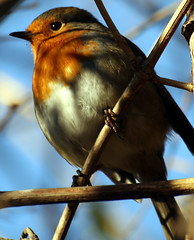


I often hear the woodpeckers drumming in early spring, in the hollow trees down the hill. We only rarely see a Green Woodpecker, but regularly see the Spotted ones about the place.

Buzzard:
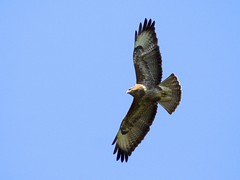


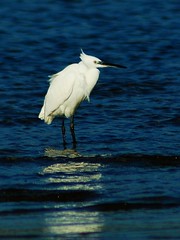
We have Buzzards a-plenty, soaring high above the house, or perched on nearby trees. They nest in the woodland on the almost verticle hillside below us, and swoop low across the road as you ride past. I like to see them in the early morning light, hunting for worms as the sun warms the slope of the little field on the hillside. It is hard to imagine such a regal bird "worming" but when I drive down to Whitemill, there is a field there with Rich Pickings, and I once counted over 2 dozen Buzzards, well spread out, hunting for worms, and keeping company with the Herons, whose Heronry is in the dense oak woodland on Merlin's Hill. On frosty mornings they are perched along the hedgerow, waiting for the ground to thaw sufficiently. One winter morning this year, I even saw a Little Egret by the side of the River Towy. I was driving, unfortunately, so couldn't look too long and hard, but there was no mistaking it.


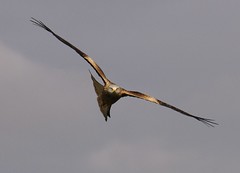
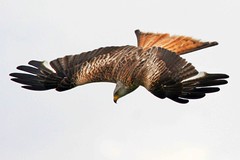
It is the Red Kites I love best, with their forked tails and rufous rump, and their splendid wings which arch and flare, unlike the little short stubby Buzzard wings. I could watch them for hours as they glide on the thermals. We see them regularly - they nest further up the valley. They were almost extinct once, killed by over-zealous Gamekeepers, but have now been reintroduced into England too, and are thriving. I always get a thrill when I see one and can understand why Sea Eagles were buried with the dead at Isbister, the 'Tomb of the Eagles' up in Orkney. They must have been the 'totem' bird of that Neolithic clan.


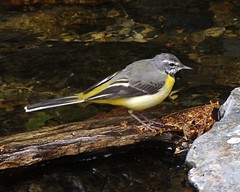
We have our share of the Wagtails too - "Polly Dishwashers" as my mum used to call them - I don't think it's purely a Hampshire name for them though, as it's used in the West Country as well. We have the little black and white Pied Wagtails, often seen along the top of the farmyard walls, looking for insects, or on the ridges of the barns opposite, keeping company with the beautiful Water Wagtails (Grey Wagtails) which have sulphur yellow rumps. When I was little, I used to look at the illustrations in my little Observer's Book of Birds, and think they had got the captions wrong, as the Grey Wagtail had lots of yellow and the Yellow Wagtail had lots of grey! Sometimes when I am working in my sewing room in the attic, I open the Velux window in the roof and, standing on a chair, look out at the countryside, and watch the Water Wagtails stuttering along the roof tiles. They are so elegant.


Sometimes I see chains of Long-Tailed Tits in our hedgerows, and once there was a nest of theirs in a dense part of the hedge by the stream. They are such pretty little birds. So are the Goldfinches, which come and feed on the Teasels by the paddock each autumn and must nest somewhere locally too.

Down by the river we see Herons daily, unless the river is in spate, and often see the whirring flight of the little Dipper as he flees downstream. They nest under the bridge, and I love to stand on the bridge and watch them bobbing up and down on a rock mid-stream. They remind me of Dartmoor, and the fast-flowing streams and rivers there, and are still magical to me, who grew up amongst the chalk streams and rivers of the Itchen and Test. Once in a blue moon, we see the Kingfisher - a flash of turquoise and he is gone. I've only seen 4 or 5 in my entire life.

Meanwhile, I bird-spot when I can. No great rarities (apart from the Egret) but much pleasure all the same.

Wednesday, 26 March 2008

A meme via Rowan

This is a little yard and building off the main street in Llandeilo. Intrigues me.


I love things like this. On Rowan's blog, she has been tagged for a meme, and as this one is a bookish meme, I thought I would join in.


The rules for this meme are:

1. Pick up the nearest book (of at least 123 pages).
2. Open the book to page 123.
3. Find the fifth sentence.
4. Post the next three sentences.
5. Tag five people.


'She looked so strange, standing there in the fold, with her long staff and red cross-over shawl, with her mouth a-tremble and her eyes shining like a prophet's, and the great lean pigs gruntling and snouting around her, and Sarn Mere standing up beyond her like the blue grass round a figure in a church window. I wondered if ever they put pigs in church windows, in pictures of the Prodigal Son, and I couldna help but laugh a bit in a kind of pitiful way, thinking that this here was the prodigal mother, and how glad we'd be if Gideon was a big prodigal too. "What ails you, laughing?" she says.'

This is from "Precious Bane" by Mary Webb. I have cheated a tiny bit and started with the 5th line, as it makes a lot more sense that way, and is a beautiful piece of prose.

I will tag five people, but there is no absolute obligation to join in - only if you feel like it:

1. Nancy
2. Leanne
3. Yarrow
4. Pixiedust
5. Kelli


A Walk around Dinefwr Castle

(Click on photos to enlarge).

Newton House, Dinefwr Park:


Yesterday my eldest daughter had a yen to go "Castling", which isn't too difficult to do in our neck of the woods, as there are plenty of them. We drove up the Towy Valley to Dinefwr Castle. It is the most beautiful parkland to walk across, and this time we chose to park near Newton House and approach the castle that way, past the deer park. Of course, I had my camera with me and took about 40 photos.

This part of Wales was the Kingdom of Deheubarth in Medieval times and the position of Dinefwr, on its rocky promontary high above the watery wastes of the Towy Valley, was a stronghold for the Princes of Deheubarth. The castle, in its earliest form, is first mentioned around the 12th century. It is linked with the Lord Rhys - Rhys ap Gruffydd http://www.castlewales.com/lrdrhys.html
who was one of the greatest Welsh leaders of the period.

I love these old estate houses at the back of the Big House.

The lane going down past the deer park towards one of the estate houses.


The first view of the castle through the trees.


This summerhouse was built on top of the main keep in the late 17th century and this and the southern turret were roofed and had tiled floors, and used for entertaining guests visiting Newton House, across the park. Following a fire, when the roofs were destroyed, the castle fell into disuse.

A view across the Towy Valley, with the loops and oxbows of the river.

I overcame my vertigo to climb up each tower and take photos. This is looking across the front of the northern chamber block up down the Towy Valley towards Carmarthen.

There was a small doorway in the wall, with a sign on it that looked like a man with a headache - it transpired it meant there were holes in the wall to look through! Looking left, we could see a window in one of the remaining towers, and there is a locked door leading to this room from a stairway. Spooky.


My daughter larking about!


Yours truly - a rare photo as I'm usually behind the camera!


http://www.google.com/search?ie=UTF-8&oe=UTF-8&sourceid=navclient&gfns=1&q=Dinefwr+
Castle

If you wish to explore many more Welsh castles, then this is the site for you:

http://www.castlewales.com/home.html

Tuesday, 25 March 2008

Crochet - another attempt! - and baking (always successful!)


Well, this is my first attempt at a granny square - it was the only one that I could understand the directions for! It's a Rose Square, and didn't go too badly (though it was meant to have 8 petals, not 6) until I got to the outer bit and then I lost the plot completely, but it was a learning experience, and hopefully I will be able to improve from here!


Here is Humphrey, from Lluest, have a snuggle down in the straw yesterday, when being stroked and fed Polo mints all got Too Much for him!


Here is Pryderi, who used to be bolshy and difficult, showing that now he has done the Monty Roberts Join-up, he is now enjoying Follow Up - note he is not being held and is following of his own free will. Another pony with a future now.


There was more baking done when I returned home with two Crunchie Bars. Chocolate Honeycomb Muffins - yummy!

CHOC. HONEYCOMB MUFFINS

2 cups (300g) S-R flour
1/4 cup (55g) caster sugar
1 cup (190g) White Bits (or a bar of chocolate, chopped up into bits)
100g chocolate-coated honeycomb, chopped
1 egg, lightly beaten
60g butter, melted
1 cup (250ml) buttermilk (if you don't have any - use semi-skimmed milk and a tablespoon of cream)
1/4 cup (60ml) honey
1 teaspoon vanilla essence

Grease 12 whole muffin pan (or line with cases). Sift flour and sugar into large bowl, stir in White Bits and honeycomb, then remaining ingredients. Spoon mixture into prepared pan and bake in moderately hot oven about 20 mins. (My oven is on 180 deg.) Add a large spoonful of Nutella to mixture for real decadence!

Monday, 24 March 2008

Lluest Horse & Pony Trust Open Day

(Click on photos to enlarge).


This is a local charity which I support, and do some of the advertising for. I will be helping out at their Open Day today, camera in hand, and I'll be baking a batch of Blackberry and Apple Muffins shortly to take along. The little chap above is Zorro, who was found abandoned and it transpired that he had been born with a condition where his "wedding tackle" was inside rather than outside and this required a very costly operation to correct. He was also gelded at the same time. He is quite a character, as you can see from that cheeky face.


The Trust do wonderful work, taking in elderly and unsound horses and ponies to give them a home for the rest of their days, as well as taking in traumatised horses and ponies and in many cases, rehabilitating and rehoming them. Young ponies are also given a future and transformed from the wormy, pot-bellied unhandled creatures that arrive, to well-rounded, well-balanced individuals who go on to be a child's best friend.


Their website is:

http://www.lluesthorseandponytrust.org.uk/

and I hope that you will check this out and if you could give a donation, it would be going to a really good cause.


Sunday, 23 March 2008

Moletraps and mustard pots . . .


Those of you who visit here regularly, will know that I have a passion for auctions and car boot sales. Most Sundays we visit our local car boot sale, and whilst I have been to better, it satisfies my love of a bargain. We usually get free range eggs from one of two stalls down there; we also buy excellent organic meat from one of two farm shops which also regularly have stalls there. I trust their produce, especially the local farm shop which we have visited, and seen their livestock and poultry living in excellent conditions, and with excellent stock husbandry. I would far rather the farm had my money than the local supermarket and I would far rather eat meat that I knew had lived a good life and died a good death.

It's usually books I am looking for, but though I cast my cosmic wishes on the wind this morning, there was little to interest me. Having given away a copy of Mary Webb's Precious Bane recently (I had it for 20 years and never read it), forum friends were discussing it and one of them, Leanne, has kindly sent me a spare copy (stamps are in the post Leanne!). Now I am looking for more of Mary Webb's books. I also look out for costume jewellery for our eldest daughter, who collects it and wears it with great style.


The weather was absolutely foul, but there were a few hardy souls who had arrived late and had to set their stalls up outside the big shed where most stallholders had set up this morning. It depresses me to look at some stalls - especially the "Manly" ones where someone is getting rid of the contents of their old barn and all that is on offer is a selection of rusty chains, rusty garden tools, chipped earthenware bottles and - this morning - mole traps, rusty of course! On another stall I was quite taken with some pretty patterned china salt and mustard pots, in Imari colours, but the lids were nickle plated and spoilt beyond saving. I bought peanuts for the birds - they still need feeding with this dreadful return to winter weather - hailstone showers every hour or so - two craft magazines and a cookery book for one of my girls. My husband got some classic brass handles for one of his restoration projects, upholstery pins for one of mine, and a little brass reproduction kettle crane which I've polished up and will be fitted to the solid oak upright of the oldest doorframe in the house (off the kitchen and dated to about 1700) to hang my aprons on. All money spent to support a local and not a global economy, buying things which are largely 2nd hand and giving them further useage - not chucked out for landfill. Even broken furniture is sometimes of use to us, because my husband restores furniture for our use, and sometimes needs barley twist legs, or a piece of old oak or a back splat from a chair. We have no time for this throw-away society we live in.

Here's my next upholstery project!

Saturday, 22 March 2008

Stormy Night


STORMY NIGHT

The treacle-black shadows are streaked with silver,

As the moon peers from behind clouds

Shredded and ribboned by the gale

Tearing through branches, nipping at rooftops,

Bullying plastic, bowling with flowerpots, sighing in corners.

Between gusts, a cow bellows for her calf,

The dog runs rabbits in her sleep,

A cat, fat as butter, licks dainty moonlight paws.

The bats scratch their toes on the plaster as they hang

Liked smoked herrings, in the wall above the window.

The stream hurls itself in solitary confinement,

Straining for release from its banks.

The North wind plays the sash window,

Squeaking it like chalk on blackboard.

Fusilades of hailstones rattle against glass like musketfire,

And the giant fir trees on the hillside bend pliant fingers

In obeyance to the storm.

Ivy leaves stutter against bark

And owlish eyes peep from gloomy fissures

As mice creep in the prancing bramble brakes.

Domesticated witterings again

Lemon Meringue Pie. I haven't made one of these for many a long year. My mum used to make them, but always cooked them too quick so the meringue was very soggy. This cooked for an hour and the meringue was just right. So was the lemony-ness. I shall have to do a lot of walking to walk off the calories from my several pieces of this!


My eldest daughter is a good cook and enjoys baking. This is her Lemon Drizzle Cake, baked when a friend was coming round. It is also Rather Good - and bad for waistlines!


This is the Manderin Orange Trifle I made in honour of my daughters coming home for Easter. I always vowed I hated custard and didn't like trifle because of that, and then I tasted some again in the last year or so, and found that I was mistaken - I DO like custard, and I LOVE trifle!


My first efforts at crochet. As you can see, the earliest (smallest) pieces were fairly pathetic and I found it difficult to keep to the same number of stitches that I began with, hence the bell shapes! Then it began to fall into place. I learned my doubles, half trebles and trebles and I am HOOKED! I found out a couple of things I was doing wrong, and held the thread in a better way too. I am now trying out my first granny square, having perfected making the little circle to start and am now on petals, and have mastered those - though I have 5 instead of 8 (ah well!) It is a very compelling craft and I find it hard to put down. It really is a craft you learn through your mistakes.

Friday, 21 March 2008

8 facts about me you probably didn't know


Nancy over at http://morthanenough.wordpress.com has tagged me to join in a bit of fun: 8 facts about me you (probably) didn't know. So here goes:

1. I hate milk (tolerate it in tea) and so I eat my breakfast cereal dry or with a yoghurt.

2. I'm afraid of heights. I never used to be. This is genetic and I blame my mother. Even looking up at tall buildings gives me the heeby-jeebies these days.

3. All my life I have professed to hate custard and never ate trifle. Now I find I was mistaken.

4. I used to work with horses. It wasn't like work at all as I loved the job so much.

5. I have a certain amount of psychic ability.

6. I represented my school at High Jump.

7. My undergraduate dissertation jointly won the Royal Archaeological Institute Dissertation prize for 1999/2000 (it's judged on the best dissertations for a 2 year period). I am still inordinately proud of that.

8. Swimming is not my strong point.

Dowsing, and St Dogmaels


Several years ago now, I belonged to our local Dowsing Society, which was one well-known and supported from quite far afield. Sadly, the society subsequently went pear-shaped. Anyway, my eldest daughter and I went along to a few meetings, and learned a little about dowsing.

Anyone can dowse. Strictly speaking, you don't even need the L-shaped brass rods that everyone uses, once you are sufficiently in tune with your body, you can just use your hands. The brass apparently allows you to more easily pick up on the magnetic fields which emanate from what you seek. This occasionally works for me with books - choosing the right one for a project . . . my hand is "led". It is a means of finding something - water is the medium most commonly searched for - and it used to be a forked hazel twig which was used to find it. There is a man in our area, who drives a large and expensive 4x4, and who tells farmers where to dig boreholes for water. He is always right, but I think his skill lies as much as reading the landscape as in dowsing, and has obviously built up a good business on the strength of it. You can use a crystal as a pendulum to search for lost rings or things, or even tell which sex a baby will be by using a gold wedding ring on a piece of string. You first have to establish which movement of the pendulum in a certain direction is "yes" and which "no". This movement of the pendulum is caused by it picking up minute and unconcsious movements of the body.


To my mind this has nothing to do with anything remotely paranormal - it is from an internal sensitivity, which responds to a given question. I think of it as "tuning in", pretty much the same as when one picks up on atmospheres - as when you can always tell when there has been an argument just before you walk into a room, it is "in the air" almost. Tests in Munich proved that only 6 of 43 dowsers who showed some aptitude in screening tests went on to display great skill, but this proved that "in particular tasks, (they) showed an extraordinarily high rate of success, which can scarcely if at all be explained as due to chance ... a real core of dowser-phenomena can be regarded as empirically proven" (Wikipedia entry). However, a later test (also in Germany) proved that dowsing was no better than chance. I will leave it to you to decide.


Anyway, I digress, as I meant to say that we had a lovely day out with the Dowsers to St Dogmael's Abbey in Ceredigion (Cardiganshire). From the Dowsing point of view it was a waste of time, totally, but the Abbey ruins were very interesting, as were the Early Christian Monuments within the church (one of the Dowsers maintained he could pick up something sinister from one of the ECMs - hmmmm). There was also an excellent Water Mill which had been there from ancient times. I love Mills, and I love stoneground flour for breadmaking. They deserve a seperate post. On this occasion, there was nowhere selling food, if I remember rightly, so the only grub to be had were some baked goods from the Mill and of course, I bought some flour for bread-making when we got home.

As for the dowsing - well, never in a million years would I be able to find "a bubble of energy" on a blade of grass and when not one of the Dowsers, including the teachers, could find their own name written on scraps of paper face down amid the ruins, I began to have doubts about their abilities . . .


But if you ever happen to find yourself anywhere near the Rollright Stones, in Oxfordshire, pay them a visit. You will be handed dowsing rods on your arrival, they have little collars around the parts you hold and as you walk amongst the stones, the dowsing rods hurl themselves in circles. Explain that one . . .

http://www.rollrightstones.co.uk/history3.shtml


http://www.cambria.org.uk/HLC/lowerteifivalley/stdogmaels.htm

Thursday, 20 March 2008

A Robert Frost poem


With both my beautiful daughters home from Uni, I have had a busy day. No time to compose a special entry, so instead I will share some more poetry with you.

I make no apology for returning to the Dymock Poets. This is an evocative poem by Robert Frost:

The Thatch

Out alone in the winter rain,
Intent on giving and taking pain.
But never was I far out of sight
Of a certain upper-window light.
The light was what it was all about:
I would not go in till the light went out;
It would not go out till I came in.
Well, we should wee which one would win,
We should see which one would be first to yield.
The world was black invisible field.
The rain by rights was snow for cold.
The wind was another layer of mold.
But the strangest thing: in the thick old thatch,
Where summer birds had been given hatch,
had fed in chorus, and lived to fledge,
Some still were living in hermitage.
And as I passed along the eaves,
So low I brushed the straw with my sleeves,
I flushed birds out of hole after hole,
Into the darkness. It grieved my soul,
It started a grief within a grief,
To think their case was beyond relief--
They could not go flying about in search
Of their nest again, nor find a perch.
They must brood where they fell in mulch and mire,
Trusting feathers and inward fire
Till daylight made it safe for a flyer.
My greater grief was by so much reduced
As I though of them without nest or roost.
That was how that grief started to melt.
They tell me the cottage where we dwelt,
Its wind-torn thatch goes now unmended;
Its life of hundred of years has ended
By letting the rain I knew outdoors
In on to the upper chamber floors.

Wednesday, 19 March 2008

The past is a foreign country

(Click on photo to enlarge).


Writing about these - mostly- infant deaths has been on my mind all day. Those I wrote about belonged to Sheffield, but countless others like them are part of the history of all of us. In my family, one of my g. grandmothers had three children under 5. Within the space of a week they died - two on the same day. I should imagine it was Scarlet Fever or Diptheria - I have never had the heart to send for the death certificates. That would bring reality too close. How did she cope? It was 8 years before she had another child, my g. grandfather. She had another two children, one of whom died, or was killed, in his early 20s. Someone on a family history forum had actually seen the gravestone recording these childhood deaths (the family must have saved for years to afford it), and they said it was the saddest thing they had ever seen. She asked to be buried with her children, and was.

Then I think back to my late mother-in-law, whose father had died on the Somme in WWI, and her mother was left to bring up 4 children under 6, and work full time in a laundry till 10 o'clock at night, leaving the youngest children with an elderly lady to look after them. This elderly lady was so poor that when the few hens she kept in her back yard started laying eggs without shells - either because they were so old or lacked grit - she could not afford to replace them - or buy eggs. This same lady, when her varicose veins burst, couldn't afford to call in the Dr. I think of my mother-in-law telling me they had bread and margerine for dinner and "Pan 'aggy" for tea - potatoes fried in bacon fat, and when the end of the week came round, sometimes it just had to be "kettle broth" - which was a little bread, with salt and pepper and steeped in boiling water from the kettle. That is not a great step from those Sheffield families.

I think of my g.g. grandfather and his brothers who had to carry on working as agricultural labourers until they were so infirm they could no longer do so, and then the Workhouse stared them in the face. Then there were their children, who were sent out to work in service or living in on a farm, so they had better nourishment and there were less mouths to feed at home. Is it any wonder so many families emigrated when they had the chance?

I was brought up in an age where make-do-and-mend was essential. There was no "keeping up with the Jones" because the Jones had no more than you! We used leftovers, never threw any food away, I was used to hand-me-downs, and we shopped for clothes at Jumble Sales as often as not, or there was always the "Club Book". We went blackberrying, used all the fruit which grew in our garden - not as some people I know, can't be bothered to pick it and let it rot on the ground and buy apples from Tesco. It was the norm for people to have a few chickens in the back garden, and to grow their own vegetables. Mum went shopping with a string bag, had a copper and not a washing machine, and leftover meat was kept in a meatsafe in the larder. Sometimes I feel quite old . . .

In these days of conspicuous consumption, when footballers buy a perfectly decent house and tear it down to build something they deem grand enough for them; when one man who was mentioned in the newspapers only ever wears brand new straight-from-the-packet underpants and them throws them away after one wearing; when people get into debt to live lifestyles like the celebrities they read about in the papers; when women spend more on makeup in a day than my dad earned in a fortnight back in the 70s, I wonder about this flaw in mankind: this desire to outdo; this repetition of Potlatch ceremonies once carried out by Native American Indians when they burned blankets and traded belongings to show that they were so wealthy and important they just didn't need them. They do say, there's nowt as queer as folk . . .

Pity the little children . . .


I blame my daughter - the eldest one that is. She has been doing graveyard research in one of her Uni courses and led me to a fascinating website set up with information about burials in the Sheffield General Cemetary. Link: http://www.gencem.org/ The period I was looking at - 1836 onwards - made grim reading. Infant mortality was very high and about 80% of the burials were children, often small babies.


The causes of death included (W)Hooping cough, Croup, Convulsions, Measles, Scarlet Fever and inflammation of the brain or lungs. A one month old baby died of St Anthony's Fire - Erysipelas. I have had some experience of this - in my horse - it is a Streptococcal infection which needs to be swiftly treated. Neglected and death can occur from septic shock or even necrolizing fasciitis - the flesh-eating disease which has been in the news recently. Poor little mite. Many children died of water on the brain, which can be a side-effect of meningitis or of a general infection. Many children were said to have died from "teething." A 3 month old baby died from Cutaneous disease - a bacterial infection? A child of 4 died of Dropsy. A 2 year old died from a neck tumour. English Cholera was not unknown and was the term given to various diarrhoeal diseases. Interestingly, diagnosis was more precise if you came from a well-heeled family, who could afford a decent Doctor and diagnosis - not that he was any more capable of saving the life. Spare a thought for those in the workhouse - where the choice of fatal infection was much broader. There you could die of Scarlet Fever, Smallpox, (both at the same time in one case), Consumption, and even Typhus (which was typically spread by body lice). One year old twins Grace and Prudence Boyland died on the same day in the Workhouse of Scarlet Fever . . . With the mothers often sickly and malnourished, it was no wonder that the death toll was so high.


Amongst adults Consumption was a common cause of death, as was natural decay and apoplexy amongst older people. A Solicitor died of Typhus, someone else apparently died of Consumption after an ulcerated leg. A Merchant had putrid fever, another worker died of Locked Jaw (Tetanus). Stomach Cramp, Bladder inflammation, Windpipe Inflammation, Decline from a wound in the foot,Lung inflammation and childbirth all took their victims. Two, an 11 week old infant and Mary Hunter, aged 66, defied diagnosis and "Sudden Visitation of God" was put down as their cause of death . . .

No-one was exempt - the dead and the parents of the dead were hosiers, soldiers, brewers, brass casters, table knife hafters, file smiths, solicitors, butchers, frame smiths, stove grate fitters, gardeners, farmers, shoemakers, spring knife grinders, pawnbrokers, whitesmiths, excise officers, razor smiths, joiner's tool manufacturers and merchants.

This link makes interesting reading:
http://www.makingthemodernworld.org.uk/stories/the_industrial_town/06.ST.02/?scene=5&tv=true

Tuesday, 18 March 2008

The Mistletoe Bough and ghostly thoughts . . .


This is for Pixiedust, who, a Hampshire Hog like me, asked for a Hampshire ghost story.

Several houses are connected with the legend of the Mistletoe Bough. Marwell Hall near Owlesbury (pronounced Ozzlebury when I lived in Hampshire) is one of them. This tragic legend tells of a bride who plays hide-and-seek on her wedding day, but is never seen alive again. She is the first to hide, and running up to the attics of the house, finds an old chest and climbs in. Once the lid is shut, she finds to her terror that she is unable to open it again, and search as they might, the groom and wedding guests cannot find her. Centuries later, the chest is finally opened and her skeleton, in her wedding finery, is discovered. Not quite a "ghost" story, but a bit spooky. Here's a link to some more information about this legend: http://www.users.dialstart.net/~2metres/poetry/mistletoebough/mistletoebough.htm

Chilbolton Rectory is said to be haunted by the ghost of a nun. Even though the window where she was usually seen was bricked up, her apparition continued to appear at the rectory. A guest there said that he had seen a beautiful nurse looking out of a different window; and another woke in the night to see a nurse standing beside his bed. The rector was unable to account for the "nurse" as no other people were resident in the house at that time. Apparently in 1393 a nun called Katherine Faukener had fled the nearby Benedictine Abbey of St Cross at Wherwell. 7 years later she returned, but it is said that she was walled up alive in an area of the nunnery which later was the site of the Rectory.

I know that in a pub the Haunch of Venison in Salisbury, where I used to go with friends, when restoration work was being done the workmen found a skeletal hand, holding playing cards. They had a mock-up made of this - a grisly reminder not to cheat at cards! Some of the fascinating history of the ancient building is to be found here: http://trustedplaces.com/review/uk/salisbury/bar-pub/1x8iv7/the-haunch-of-venison/1j11a8


Whilst I have never seen a ghost, I do feel atmospheres. I used to walk the dogs in the grounds of what had once been a gigantic hospital at Netley, built to house the sick and wounded from the Crimea War - hospital ships were able to moor alongside as it was at the edge of Southampton Water. The hospital had been a quarter of a mile long. It was demolished eventually, but the chapel building had been left. Well, chapel or no, I couldn't go anywhere near it as I felt the most appalling depressive atmosphere. I could walk through the war cemetaries there, and only felt peace, but that chapel fair set the hairs up on the back on my neck. A couple of years ago I happened to mention this to a friend, who had lived near Southampton for a while and knew of the place. A friend of hers took her children there (it had become a Country Park by then) and they were just walking near the chapel when her little girl started waving. She asked her why she was doing that as there was no-one to be seen. "I'm waving to the men mummy," she told her, "Look, over there, they're waving back and they're coming to see us." Exit - extremely fast - one freaked-out mother and her little ones, never to return . . .

Here's a link, which shows both hospital and chapel: http://en.wikipedia.org/wiki/Netley_Hospital

Monday, 17 March 2008

Canals

(Click on photos to enlarge.)

Canalside cottages and narrowboat at the canal basin in Brecon town. What a fabulous display of flowers. We had a lovely day out here last summer, walking along the canal bank.


The Montgomery Canal, which I was driving past on my way up to North Wales and Beyond a couple of days back, has been recently restored, having been abandoned around the Second World War after part of it was breached in the 1930s. It was not considered economically viable at that time. Now the restoration of all but a short stretch which is privately owned and dry, has enabled the canal to be used for recreational purposes (mainly boating). Downstream:


The view upstream:

The canal was initially started after 1794 and by 1797 a 16 mile stretch had been constructed. It eventually stretched from Llanymenach (where there was a large limestone quarry) to Welshpool and differed in purpose from most canals, as it was primarily used to bring lime, which was necessary for agricultural purposes to improve the land in the North Shropshire area. Indeed I noticed and photographed the small lime kilns beside the towpath at Buttington Wharf. There are long rows of these on the Brecon canal too. Lime could be a dangerous cargo, as once mixed with water, it became caustic paste and capable of causing nasty burns. Hence the need for it to be processed close to the canal so it was in a safe condition to be carried on elsewhere to farms. The limestone would be broken up by heavy hammers and layered with coal, into the lime kilns, where it would be burnt in what essentially was a large furnace and the lime which issued from the bottom of the kilns could then be safely transported. The top of the kiln was level with the edge of the canal so that the lime could be easily manouvred into it. During 1841, up to 58,000 tons of limestone were carried along this canal, and there were a total of 92 lime-kilns along its length.


One of a long line of larger lime-kilns at Brecon:


A beautiful canal-side garden at Brecon:


The Brecknock and Abergavenny canal carried different cargoes: coal, lime and limestone, iron and timber. Building stone, hay, farm produce and manufactured goods were also carried. At Llanfoist, near Abergavenny, the canal was linked by a tramroad to the ironworks at Blaenavon. At the height of the Industrial Revolution in Wales, the canals were the quickest method of transport, as the roads were so bad. With the advent of the railways, however, the canals seemed very slow by comparison. Conditions in winter were bad however and the conditions which Dickens wrote of, when the Thames froze over and Ice Fairs were held, affected the Welsh canals, which also froze, and special ice-breaking boats were employed to create a route through. It was linked with the Monmouthshire canal near Pontypool.

This link gives an excellent overview of the locks and aquaducts which were a necessary part of the canal system: http://history.powys.org.uk/school1/brecon/levels.shtml


http://history.powys.org.uk/school1/welshpool/lime.shtml

is a good link, as is: http://en.wikipedia.org/wiki/Montgomery_Canal

Sunday, 16 March 2008

There and back again . . .

(Click on photos to enlarge)


Well, I'm safely home from collecting my daughter from Uni. I am NEVER going to travel on a Friday again though, the traffic was horrendous in Stockport and I somehow managed to get distracted by someone beeping behind (not at me as far as I know) and ended up in the wrong lane off the roundabout and heading back the way I came, so I had to head x-country over the Derbyshire moorland. Some of the area I know a bit, so I knew which bits to look for but sometimes I had to stop and check the map, and when I did, I got my camera out!


The journey back yesterday was more straightforward and a lot less "heavies" on the road. We decided to stop for lunch at Welshpool, as it is many years since I was last there, and besides, the Charity Shops of Oswestry (where I stopped on the way up) didn't tick the box as far as books were concerned. Welshpool was far better and I came away with several, including an oddball theory about burial chambers from the Neolithic being based on seals (!!!). There were so many photographs I had wanted to take but was unable to stop anywhere near, and I was particularly disappointed I couldn't take some of the peculiar sulphur yellow colour some of the mosses had turned and this juxtaposed with striated grey rockfaces, and dead bracken etc really took my eye. I did stop off at Buttington Wharf (just outside Welshpool) and took some photos of the canal there. I want to do some research about it and then I will share it with you, but meanwhile, here is one photo to keep you going.


Thanks to all of you who visited my Show and Tell yesterday and I shall get around to visiting your sites this evening and tomorrow.

Friday, 14 March 2008

Some Dorset Folklore - the Screaming Skull of Bettiscombe

Mexican craft skulls in Los Angeles! I didn't want to scare anyone away with a photo of a moldering skull . . .

One of the Dorset legends which was familiar to me when I lived in Dorset was that of the famous Screaming Skull of Bettiscombe Manor. The legend associated with this skull states that if the skull is removed from the house, great disaster will befall both house and occupants.

The skull was said to be that of a Negro Slave, brought home from the Indies by Azariah Pinney, who had taken the wrong side in the English Civil War, escaped execution by the notorious "Hanging Judge" Jeffreys, being banished to the West Indies instead. On his deathbed, the slave begged that his body be taken back to his homeland for burial or a terrible fate would befall Bettiscombe. Azariah agreed to this request, but following the slave's death, renagued on the agreement and had the slave buried in Bettiscombe churchyard.

However, no sooner was the slave buried there, than dreadful shrieks and screams of a spectral nature, and poltergeist activity within the house, led to the body being exhumed and returned to the attics of Bettiscombe. Now only the skull remains. In the 19th century, a disbelieving owner threw the skull into the pond in the grounds, but for days following this deed, screams and tremors shook the house and it was retrieved and replaced in its resting place.

Above: Panorama of Pilsden Pen area. However, in the 1960s the skull was carefully examined by a pathologist, who concluded that it was NOT the skull of a Negro male, but a European woman's skull of about 20 years old at time of death, and it was between 3 and 4,000 years old, thus dating from the Bronze Age. Its fossilised condition was believed to have been caused by it being submerged in the bottom of a nearby well. Since Bettiscombe is at the foot of Pilsden Pen, which was an Iron Age hillfort, it is quite possible that the skull was deliberately placed there in a ritual context. In the Iron Age (and before and dare I add also since) - watery places such as wells, lakes, rivers and springs were believed to be liminal areas where a pantheon of gods and goddesses could be contacted or placated.

Now, here's a strange thing. I was looking for books on Dorset for a post over the weekend, and my hand drew out "Tales of Dorset" by Olive Knott. This is a book I haven't looked at for many a long year, a 1976 reprint of 3 little books published in the early 1950s and speaking of people and events of 50 years earlier. Even stranger was when I was flicking through the pages, from back to front as I always do, and the word Pinney jumped off the page. I found it in association, not so much with Bettiscombe Manor, but with a house called Racedown, which John Frederick Pinney, Azariah's cousin, had built in the mid-18th century. Azaria even lived there with John for a couple of years before his death. Both cousins were buried side by side in Wayford Church. Racedown became connected with the Wordsworths (William and his sister Dorothy) who lived there for nearly 2 years from September 1795 onwards, and it was here that Wordsworth wrote two of his poems, "The Borderers" and "Guilt and Sorrow". Letters which were kept from that time resurfaced in the mid-Victorian period, and included a fascinating paragraph:
"One June day a tall, pale-faced young man leapt over the gate into the meadow and ran down to the house." It was Samuel Taylor Coleridge. In 1797, Coleridge invited the Wordsworths to come and stay at Nether Stowey with him and they left Racedown forever. The rest, as they say, is history . . .

Another strange thing - also in the same book was an article about a Dorset place I was going to research and write about next week . . . It would seem I have perfected the technique of dowsing with my hand . . .

Friday - Show and Tell over at Kelli's

Show and Tell


Although I'm participating in this week's Show and Tell, I am away until tomorrow evening so I won't be able to post your comments or check out your show and tells until my return. Please leave a comment - it will be lonely without you!


This is a pair of small jugs I got at the Car Boot Sale last week. I collect Crinoline lady china and I collect jugs, so these ticked two boxes! They're in perfect condition and even though there wasn't room to fit even a wee Crinoline Lady on the tiny jug, it's still sweet.


As you can see, they fit in well with the other two jugs I have of that pattern. They live on the slate slab on the half landing going up to the attic. A perfect place for china collections . . .


A couple more pieces of Crinoline Lady china, bought many years ago at auction. I love the Wisteria trailing on the little vase to the left.

Click on the photos to enlarge them, so you can see the design properly.

Lastly, someone requested a picture of my oak corner cupboard and last week's plates in place:


The corner cupboard is an old one and should stand on a matching stand, but when we bought it, covered in chicken feathers (and worse!) the base was no longer with it. The bottom half is hidden behind our sofa and it contains some of my crafting materials. Between the two plates is a little glass candle holder which throws out pretty colours through the glass when the candle's lit.

Thursday, 13 March 2008

Wart charmers and other folklore


Many years ago, when your granny's mummy was just a lass, there were people who might claim to be wart charmers. For a small fee, they would offer to "charm" a wart away. In the Wessex of my childhood, various remedies were used. One I heard of was to rub the wart with bacon fat, and then bury the piece of bacon and as it rotted, so would the wart fade. In smart circles, a piece of steak served the same purpose. Others swore by covering the wart with cobwebs, and then burning the latter. Incidentally, cobwebs were always tolerated in stables, as they could be used to stop a wound bleeding (it doesn't do to dwell too long on all the dust and bits of chaff the cobwebs also trapped . . .)


The Elder (which has many useful attributes) was the remedy for other folk - a young elder shoot would have as many notches cut in it as there were warts to be cured and then buried. However, if someone were to find it and pick it up, the warts would be transferred to them . . . apparently. Others, it was said, had a rather more sinister cure, which was to use the blood of small animals such as cats, mice or moles to rub on the wart (fortunately there is no mention of them being buried afterwards . . .) I was told by a lass who grew up in post-War London, that she and her friends used to use the juice of the Greater Celendine (which is egg-yolk yellow!) to treat warts. Apparently it grew on bomb sites, along with the Rosebay Willowherb (some folks call this Fireweed). Fig leaves or dandelion stems were also employed.


Certain plant-based cures were tied to certain parts of the country. In Somerset, along with Huntingdonshire and Lincolnshire, the soft inner part of the broad bean was used to rub the wart, or else the runner bean; in Devon, the Buttercup was known as the "Wart Flower", whilst the Euphorbia family were also used and the Sun Spurge had the alternative name of "wartwort" - which tickles my sense of humour somewhat! In Lincolnshire, the Petty Spurge was called "wart-grass". Red Campion, Toadflax and Scarlet Pimpernel were also employed in the same fashion.


Toadflax


Red Campion

Scarlet Pimpernel

Not that you'd be interested, but these all grew in and around the wild part of our garden when I was growing up.

An American website records a piece of cotton being tied around the wart, and then the thread was buried with the usual "as it rotted" line. The bacon or steak was replaced by rubbing the wart with a Cockerel's comb and burying that. Vegetable cures included rubbing milkweed juice on the wart or rubbing it with a piece of wild turnip. Pokeweed roots were cooked in grease and the resulting mixture rubbed on the wart. After 4 or 5 applications, the wart would go. Rubbing the wart with an old bone was another remedy - and you then chucked the bone over your shoulder. A plaster of brown soap and spit was also apparently efficatious when applied for 24 hours.

Bouncing link removed! Will try and find another link to the whackier wart cures . . .

Wednesday, 12 March 2008

The Burren


The Burren is an intriguing area of limestone pavements, eroded by the beatings and strokings of Irish rain which has permeated and bored it so that swallows and cave-systems lie beneath the surface. Erosion has curved the edges into sensuous, almost molten forms, whilst the frost has created ruler-straight cracks across the surface, as if it has been tapped smartly with a toffee hammer. Jagged limestone walls roam the landscape like rows of crumbling witches' teeth, whilst the pavements are punctuated by thickets of Blackthorn and Bramble and trailings of ivy. The grey limestone pavements contrast with lime-mossed stones, cattle-trampled black earth, blades of straw-and-emerald coloured grass. It is an eroded landscape, where the earths' bones seem to protrude and yet be integral to the whole.

There are 360 degree views, which doubtless drew the builders of Poulnabrone, one of only two Portal Dolmens in this area, though there are more than 60 Wedge tombs and many other burial sites. There is still a sense of place here felt by today's visitors, who build mini-dolmens across the pavements, like little stone echoes.

It is an echo of a past landscape. Once this was wooded. Sheltering in the cracks are relict plants from the Neolithic - Woodsage, Primroses, and even a glacial relict, Alpine Lady's Mantle, a survivor from before the woodland.

So I wrote in the introduction to an essay on the Neolithic following a Field Trip to Ireland over ten years ago now. I can still see it so clearly in my mind's eye, and would love to return, without the constraints of a limited visit and the need to move onto the next item on the agenda, at a time when the wild flowers colour it rainbow. Here is a link you may wish to follow up:
http://www.burrenpage.com/

Tuesday, 11 March 2008

Old Documents


I love researching. I love old documents - not that I often get to see the like of the one in the above picture though. Today I spent the morning at the County Records Office, where I started off researching one thing, looking through old newspapers from the late 1830s , and ended up jotting down all sorts of obscure bits and pieces too. I started with the Indexes and really MUST go back and look up this enigmatic comment: 26 January 1872: Swansea Police - Thomas Richards of Knelstone, fined 20 shillings or 14 days' imprisonment for riding without reins . . . The mind boggles.

On the 9th November 1839, there was a piece about the shennanigans at the Windsor Fair the previous year, when "the most frightful rows were got up by the Etonians, who proceeded to Windsor, 500 strong, dragged down stalls, seriously maltreated the fair folk, and violently assaulted the Police." Several Masters at the school overheard some boys planning a similar event that year, despite their being banned from the Fair. Dorms and rooms were searched and "several thick clubs . . . . heavily loaded at one end with lead" were discovered and confiscated. Even so, about 26 boys were caught at the fair, and publicly flogged next day, using the personal rods each boy possessed "every boy his own rod" - 3 feet long and of birch. They were also downgraded one term.

At the beginning of 1838, The Welshman newspaper carried a short paragraph: "Lately at the parish church of Bettws, near Abergele, Denbighshire, Mr Owen Williams of Llansaintfraid, to Miss Sarah Jones of Bettws. Each party was above 65 years of age. They had courted above 40 years, he having to go and return a distance of 7 miles to see his sweetheart, and the journey he never failed to perform once a week. Thus in the space of 40 years he walked 29,120 miles on love expectations!" One wonders why they delayed so long in tying the knot.

Another small paragraph mentioned the British were very bad at making tea, and often left the brew to stand for too long. A Jesuit from China declared that "to a drachm of tea they (Chinese one assumes) put a pint of water and frequently take the yolks of 2 new laid eggs, and beat them up with as much fine sugar as is sufficient for the tea, and stir them up altogether . . . . ." Urgh!

Mind you, perhaps if folks did make tea that way then they would be in need of Dr John Armstong's Liver Pills or Dr Brandreth's Vegetable Pills (this latter a safe antibilious medicine). Anderson's True Scots Pills for digestion might also be helpful, or a drop of Dicey & Co's True Daffy's Elixir. Coughs and colds were well treated by Bateman's Pectoral Drops, and Marshall's Heal-all was excellent for cuts, scratches and bruises. If all else failed, then Friend In Need Ointment could be relied upon . . .

Monday, 10 March 2008

Being domesticated . . .

I had the mood seize me to do some baking at the weekend, so I made a Chocolate Cake and some Cheese and Mustard Scones. I thought I would share the recipes with you:

MY FRIEND FRANCES’ RICH CHOCOLATE CAKE RECIPE


6 eggs, separated

4 oz (125g) ground almonds

6 tablespoons castor sugar

8 oz good quality chocolate, broken into pieces

2 tablespoons milk

Firstly, place the chocolate pieces and milk in a heat-proof bowl, in a large pan with a little boiling water in the base. Continue heating, and stir regularly as chocolate melts. Once melted, turn heat off, but keep bowl in pan to stay warm.

Separate eggs, and beat up whites until hard peak. Combine egg yolks well with a fork and reserve. Place ground almonds in a large bowl, and add sugar and melted chocolate/milk mixture. Mix well. Add egg yolks and combine well. Finally add beaten egg whites and gently combine. Spoon into greased and lined 8” loose-bottomed cake tin and cook in oven (180 degrees) for 30 minutes. IF allowed to become cold, this cake becomes deliciously fudgy and is wonderful with a spoonful of icecream . . .


CHEESE & MUSTARD SCONES


8 oz (225 g) Self Raising flour

1 teaspoon baking powder

Pinch of salt

50g (1 ¾ oz) butter, cut into small pieces

125g (4 ½ oz mature (sharp) cheese, grated

1 teaspoon Mustard powder

150ml/ 5 fluid oz buttermilk

Pepper

Lightly grease a baking tray. Sieve the flour, salt,& baking powder into a bowl, and rub in the butter with your fingers until the mixture resembles fine breadcrumbs. Stir in the grated cheese, mustard and enough milk to mix to a soft dough.

On a lightly floured surface, knead the dough very lightly, then flatten it out with the palm of your hand to a depth of about 2.5cm/1 inch. Cut the dough into 8 wedges with a knife. Brush each one with a little milk and sprinkle with freshly ground pepper to taste. Bake in a preheated oven, 220 deg. C/425 deg. F/Gas mark 7, for 10-15 minutes until scones are golden brown.

Transfer the scones to a wire rack and leave to cool slightly before serving.

Eat same day as they quickly go stale (though I cheat and reheat briefly in microwave).


Today, with the gale force winds and spells of lashing rain, I spent the afternoon indoors and managed to keep my nose to the grindstone and sew the quilt block for the current swop I am taking part in, so this one is for Alice, and it was fairly straightforward to piece (though I still managed to sew one part on back to front!)


Sunday, 9 March 2008

The Blizzard in the West


Last year I treated myself to a CD-ROM of this title. It is the "Record and Story of the Disastrous Storm which raged throughout Devon and Cornwall and West Somerset on the night of March 9th, 1891." That's exactly 107 years ago. My Devon ancestors lived through it. One of them, the brother of my g.g. grandfather, still living in Hennock, wrote of it to his children in New Zealand, saying that there was still some snow left unmelted some 6 or 7 weeks on. The Dartmoor writer Eden Philpotts, described it graphically in his novel The American Prisoner (published in 1904).


I think that if you had lived through it, the memory would have stayed with you forever, for “…no such storm had visited the West of England within remembrance.” The Times, March 1891.


Between the 9th and 13th March 1891, Cornwall and Devon were almost entirely cut off from the rest of Britain by a storm of such terrible ferocity that more than 200 people and 6,000 animals perished. Violent gales brought down trees, temperatures plummeted below zero and snow drifted in places up to 15 feet high. This meant that ships foundered on rocks and roads became impassable and trains found themselves snowbound in the middle of nowhere. Unable to face the blizzard, ships ran to safety in Falmouth harbour. However, not all of them made it."


One ship putting into Falmouth harbour, the Bay of Panama, foundered outside the harbour, where the decision had mistakenly been made to heave to in worsening visibility. A combination of terrific winds, crashing waves and poor visibility swept crew (including the Captain and his wife) overboard and the Mate ordered the remaining crew to climb up the rigging. They were found the next day either frozen corpses or barely cling to life. Only 17 of the 40 crew survived.

Meanwhile on land, two feet of snow fell - four feet on the higher ground of Dartmoor. Hurricane-force winds piled it into drifts 15 feet deep and 6,000 sheep perished. A total of 14 trains were stranded on their journeys, and the Princetown train ploughed into a drift on the line near Horsford Farm and the driver and 6 passengers were stranded for 3 days, being rescued on 11th March, but the train could not be moved before the 19th!. During this blizzard, which lasted 36 hours, 220 people died, mostly crew at sea where 65 vessels were lost in the English and Bristol channels.

That makes the winter of 1962/3, which I remember vividly, seem like a picnic!


Now for the strangest of strange coincidences. Earlier in the week, never having heard of one before, I discovered that you can have Moonbows. In researching this blog entry, I turned to Eden Phillipotts, a Dartmoor author who my dad told me REALLY knew the moor and described it so well (my dad grew up at the edge of Dartmoor and used to cycle 100 miles in a day all over the moor in his teens). I opened "Eden Phillpotts On Dartmoor" and it fell open at a page on his novel The Whirlwind, and this passage met my eye:

"Through the wild weather they passed, presently breasted White Hill, and bent to the tremendous stroke of the wind. Fierce, thin rain drove across the semi-darkness, and where a rack of cloud was torn wildly into tatters, the hunter's moon seemed to plough and plunge upon her way through the stormy seas of the sky . . . Then a wonderful spectacle appeared above them in the firmament.

From the depth of the northern heavens there sprang an immense halo of colourless light, where the moon shone upon un-numbered particles of flying rain. Wan, yet luminous, flung with one perfect sweep upon the storm, it endured - the only peaceful thing in that wild world of tumultuous cloud and clamouring wind. The arch of the lunar rainbow threw its solem and radiant span across the whole earth from west to east. It framed all Dartmoor, and one shining foot seemed to sink upon the Severn Sea, while the other marked the places of the dawn."

Thanks dad . . .


Some Car Boot bargains

I can never resist the lure of the Car Boot Sale, so my husband and I had a browse around our local one this morning. He is looking out for some practical stuff - screws, drill bits. I am looking out for the china I collect, oddments of wool. We both look for books!


These little jugs came home with me as I have several Crinoline Lady pieces. I found a couple of books - one on walks in Arthurian Wales and the other herbal remedies. At the same stall as the latter book I found this rather oddball rugmaker. I'm not sure if I will use it, but I can at least offer it to a friend who might, rather than it being consigned to a bin.


Finally I found this beautiful x-stitch angel, which became mine for just £2. Considering the hours of work which went into this, I reckon I got a bargain. We'll frame it up and put it in the guest bedroom.


Click on pictures to enlarge.

The Dorset Ooser and other curiosities

Here is the Dorset Ooser - pronounced Osser I believe. He is a definite link to our pagan past and how our ancestors may have viewed the world. This fierce wooden mask seems to have been linked with rituals at the end of the year. Perhaps celebrating the shortest day, when priests studied the passage of the stars and planets in the night sky to ascertain when this day fell. In Burghead in Scotland, there was a bull cult, and half a dozen slabs decorated with wonderfully-carved bulls were found during excavations there. These are associated with the Picts, and the bull is a Pictish symbol, along with other beasts including the horse, the salmon, the goose, the wolf and the deer - interestingly ALL masculine . . .

His origins are lost in the mists of time. Perhaps he was a pagan fertility symbol. Perhaps in the post-Medieval period, every Dorset village had their own Ooser head that they blew the dust off and paraded once a year, its original meaning long forgotten. By Victorian times, in the village of Shillingstone on the Dorset/Wiltshire borders, he had become a Christmas Bull. This frightening creature wandered the village streets of many a Dorset village at the back end of the year, and upon meeting a village, would demand sustenance. It was a dieing custom, however, and by the beginning of the 1900s, only Melbury Osmond still had its Ooser, and even that has now been lost to us. Interestingly, the Ooser also took part in the Skimmity/Skimmington Rides I wrote about recently.


Here is another strange Wessex being, the giant St Christopher of Salisbury, who along with Hob Nob the hobby horse, pictures below, parade on special occasions. He lives in Salisbury Museum most of the year, and is 12 foot tall, a pageant giant originally belonging to the Guild of Merchant Tailors. Once, many guilds would have had their own giant - he is getting lonely now. The head is carved from a block of wood, and at one time, the mouth could have been moved to simulate speech. He is accompanied in the procession by a Yeoman who carries his staff of office, and two men known as 'whifflers' who carry his regalia - a gigantic wooden sword and a mace. Morris Dancers also accompany him. The giant is first mentioned in 1570, but he predates that as this was a request for repairs to his costume. The actual Guild dates from 1447, so it is quite likely that the giant originated at their inception.


Hob Nob, the little black hobby horse (who was sometimes called a dragon), accompanies the giant, the body of the horse being a framework supported from the wearer's shoulders. From the framework is a long black cloth to hide the operator's legs, and a horse's head and tail attached either end. Like the giant, hob nob had jaws that opened and shut and he is first mentioned around 1572, though probably predates this.

Here in South Wales we have our own species of hobby horse called the Mari Lwyd (the 'Grey Mary' loosely translated), which parades at midwinter/Christmas/New Year. It is a beribboned horse skull, operated by a man beneath it who works a mechanism to open the jaws and make them snap ferociously as it chased the girls around the room, having been invited in! The Mari Lwyd is accompanied by Sergeant, Merryman, Punch and Judy, who will traipse from door to door in the villae, singing as many as fifteen verses in a poetic contest. It is believed to be associated with an early form of wassailing. http://www.folkwales.org.uk/mari.html

For more information on hobby horses, here is a further link:

http://www.theunbrokencircle.co.uk/folklore_hobby_horse.htm

Saturday, 8 March 2008

The Camps and Dens of childhood . . .


This was prompted by something a friend wrote on a forum yesterday, when we were listing 5 things we remembered from childhood. I immediately thought, why didn't I remember that - because I do, and so clearly.

At the back of our house was a wild valley, part of which had once been an old brickworks. Our house had once been where the brickworks manager lived. There was a gravel trackway at the back of our garden which went down to it, though going back to the area now, you would never know it as "they" filled it in and now houses are built on top. I think on local maps it was called Weston Common, but of course we never called it that. A terribly polluted stream ran through it, but we still waded through it, jumped over it, and treated it as a plaything.


I have only to smell crushed bracken to think of the dens we made in the bracken which grew in great profusion in that valley. We would crawl in a few feet, bending the bracken back to make a tunnel, but not breaking it enough so that we lost our "roof". It paid to be very short, as you had to stay on your hunkers when you were in the den, unless you could lay out flat. Here we sat and ate sweets and talked and no-one knew we were there.


We had more substantial den in the gorse thicket in the wilderness part of our garden, to the right of the house. Here, at the edge, was an old gooseberry bush, and some tall Damson trees where the nightingales perched on summer evenings, and kept me awake with their singing when it was hot and sticky and we had to have the little window open at the top of the stairs. I can still remember making that den with my friends, and saying "where there's a will, there's a way" until they must have wanted to kill me!! The gorse was incredibly prickly, and sitting down once you were in there must have required an old square of carpet or cardboard, but I don't actually remember one. It was wonderful when the gorse was in bloom and there was the strong smell of coconut from the gorse blooms. Those were "girl dens".


"Boy dens" were different - bolder, requiring more energy, and as a rule, excavation . . . The male part of our neighbourhood "gang" - only called that because we hung out together not because we were the neighbourhood thugs! - were into digging. I think we were 12 or 13 that year, and still very much in a childhood where we climbed trees, walked for miles, scrumped orchards, and played hide and seek in our wilderness. The boys dug a really splendiferous camp (note different name too) in the clay near the Wall of Death. Oh yes, I should have mentioned that "our" valley had its own topography which we named. The Wall of Death was a small pond which had been excavated for clay for the brickworks. It was a great home for wildlife, even Great Crested Newts, which were, of course, not rare in those days, let alone protected. Anyway, if you ran fast enough around the Wall of Death, centrifugal force kept you out of the water. For people who weren't in our gang - or we wished to torment (I am SO sorry Alison Hams . . .) we didn't let them in on the secret, they ran too slowly and oh dear, got very wet! Anyway, I digress, the boy's camp that summer was brilliant, dug four feet deep into the clay, and roofed over with branches and a bracken roof, it was a wonderful place to hide. Unfortunately, it was the clay which was its undoing, as we had a few wet days and the camp became a square pond with a roof!

Two lads from the other side of the valley, who we nicknamed "Froggie" and "Guess" (we never did know their real names), also dug a camp, which we used to occasionally use - always worried in case we got caught "trespassing".


My favourite place though was "Blossom Camp". It was right down by the stream bank, where there were a profusion of wild cherry trees (what I now know as Geans). In the spring, we would sit there and blossom would fall on us and around us. Once the boys painted themselves up as Indians and, realizing at the end of the day they would get told off if they arrived home covered in poster paint, we lit a fire (only the very best camps had a fireplace! ) in our rock-edged hearth, and heated up stream water in an old paint can, so they could clean off a bit.


We knew every inch of our valley, from the abandoned allotments where strawberries, raspberries and black and red-currants still grew (just the thing for a summer lunch), when the damsons were ripe for scrumping, every apple tree in the abandoned orchard opposite, where a couple of years later, Tricia and Rosie were to keep their first ponies.


We knew instinctively how to peel rush stems as our ancestors did for making candles from the pith, dipped in fat. We made mats to eat off, by weaving the flat strap-like leaves of Bullrushes. We broke open stems of what we called French Rhubarb when we were thirsty, as they stored water in the stems, and this doubled as food too, to munch on when the soft fruit had gone over. You might know it as Japanese Knotweed . . . We picked the Sweet Gale, so fragrant, and had pocketsful of the stuff. In winter we even sucked the icicles off the pussy willow branches. We slid down the very steep cliff (as we called it) by the main pond, oblivious of the fact that if we went too fast we would end up in the pond. The boys made rafts from old barrels and bits of wood and once, when they were sinking in the middle of the main pond, we had to throw them a rope to rescue them - the mud at the bottom of the pond was very clinging and the pond deep enough for drowning in.


We tied plastic bags around our feet, over our shoes, and went wading on "Flamingo Marsh", which was a fascinating place as if you jumped in one area, another area about 10 feet or so away would quiver! We took stems of grass and annoyed the tiny Sundews which grew there, as they would close on the grass tip, thinking it was an insect landing. They were incredibly sticky and sometimes we would put our fingers on them, like putting them on sticky tape.

We never realised we could run so fast until we had a brick fight with the boys one day, in the ruins of the brickworks. I was a lousy shot at the best of times, but one of my bricks found its target and I had a 14 year old boy (you know who you are Keith L) hurtling after me, intent on murder after my brick had hit him above the ear. We could also outrun the billy goat who was tethered down there, and a bit crabbit at the best of times.

But the magic died when we realised that we were growing up, that grubby knees and games of cowboys and indians were losing their appeal, the day we found some girly mags in Froggie and Guess's camp. That spelled the beginning of the end of childhood. But I have only to smell Sweet Gale, or Bracken, and I am taken back over 40 years.

Friday, 7 March 2008

Keeping busy . . . and the Hairy Hands!

Postbridge, Dartmoor - the ancient (Medieval) clapper bridge over the River Dart and the modern road bridge beyond it. Back to that later . . .

If I am worried about anything I like to keep busy. Because it was the anniversary of mum's death yesterday, I have been keeping busy by redecorating our bedroom. It has needed doing for I don't know how long - I don't think we've touched it for a good ten years. Anyway, here are a couple of photos, though I swear we didn't have a salmon pink on the walls before - it just looks that colour in the photo. On another bit it looked terracotta, but as we mixed the paint ourselves, it was probably not stirred well enough in some parts.

This pic shows the old colour, and a little potty chair we bought covered in gunky varnish and a stratetically-placed piece of linoleum in a junk shop in Manchester when the children were very little (though I didn't make them use it!) The painted wild flowers on the fireplace surround (made by OH) are mine own - I'm not so good drawing things freehand, but I can copy anything (and my dad was the same, and so are my children). These flowers came from some painted by Marjorie Blamey - I have a wonderful wild flower book illustrated by her, and she is easy to copy.

It was a deep pink before, but is now being "raspberried" - a similar colour (if not the same) as we have (with lots of white and beams to break it up) in middle daughter's attic eyrie, which is very Medieval in look.


Our room is tall and has a big North-facing window which makes it light in the daytime (unlike the rest of the house which faces East and spends all but the early morning in a deep gloom!) I made the mistake yesterday of trying to have a light wall behind our bed and sloshed some white about, but it looked foul and I then spent the remainder of the day repainting it in raspberry.

We do actually have a PAIR of curtains, but I have taken them down one at a time to wash and iron and rehang. That is also the only time you will see the top of my Beaworthy* chest of drawers bare - normally it's covered in nick-nacks and photos of the children when they were little.

(*We were given this chest of drawers in a very distressed state - imagine it grey from where it had been bunged in a damp old barn - when we were house-hunting in Devon before we moved here. I was devastated when the sale of our house fell through and Beaworthy Mill was sold to someone else, but we have the old chest of drawers to remember it by. My husband lovingly restored it.)

And the Hairy Hands, I hear you asking? Well, another of my favourite Dartmoor tales . . . I hope you're not alone when you're reading this, and I sincerely hope that it's not dark outside, and that the wind isn't wuthering around the house, throwing hail against the window panes like musket fire . . . Down on old Dartymoor, along the B3212 between Postbridge and Two Bridges is a lonely stretch of road which passes the old Powdermills near the River Dart. Just before the First World War, there were some strange occurrences hereabouts. They seemed to be focused on a stretch of the road near a farm called Archerton at Postbridge. Folk were terrified as cyclists had their handlebars wrenched from their hands so they ended up in the ditch, and a similar thing happened to pony traps - where the reins were taken over and the pony and cart ended up off the road. In the years that followed, cars and coaches were also driven off the road and a local man - Dr Helby from Princetown - was killed after his motorbike and sidecar was forced out of control. Shortly after this, an Army officer (who you think had some credibility) was badly injured whilst riding his motorbike along this stretch, but he lived to tell the tale - that "a pair of large, muscular hairy hands had closed over his own and forced him off the road."

Well, this made for sensational front page news and the Daily Mail (of course!) sent intrepid reporters to the scene to get the story and such was the furore, official enquiries resulted in the camber of the road being modified, and the accidents were attributed to an adverse camber.

So why, in the mid-1920's, did a lady in a caravan parked by the side of this very road (can't you tell she wasn't a local?!) see a very large, very hairy hand clawing its way up the outside of the window. She panicked (well you would, wouldn't you?) and made a sign of the cross, whereupon the hairy hand disappeared, never to be seen by her again. Ooooooh, that has sent SUCH a shiver down my spine!

Over a 20 year period between 1910 and 1930 there were a number of serious accidents along this stretch of the road, including another fatality, but who can say whether it was the Hairy Hands taking charge or simply an accident? All I can say is, we used to camp on the moor not too far from there, and I took great care not to have to go out with a torch in the middle of the night to answer a call of nature!

I leave you with a photo . . . of the hairy hand(s) . . . .


Thursday, 6 March 2008

Show & Tell at Kelli's

Show and Tell

Click on the photos to enlarge.


This is one of our special favourites and although it isn't particularly valuable, it is very old, and the bird (a crane) pulling the man's nose, is a wonderful piece of Medieval fun that has been carried on through the centuries. This probably dated from the late 1600s. It was obviously part of the architecture of a church, long since decomissioned, and would have been designed to teach a moral tale. Perhaps not to tell lies - shades of Pinnochio there! We love it dearly, especially as part of it is a pun on our surname.


This is another of my favourite plates. It lives on top of an old oak corner cupboard in the sitting room and would have been part of a stunning dinner service at one time. It's a big soup dish, made by Booths in a pattern called "The Pompadour". Probably late 19th C - about 1880 or so. I can't remember if this was in an auction box or from a Car Boot Sale, like the one below:


This is a real quality plate, made by Wedgewood, and with a USA Patent mark on the back, as well as the English one. The pattern is "Wellesley" and as it has "Made in England" on the backstamp, it would have been manufactured post-1892, when it became necessary to include the Made in England stamp. Whilst it is essentially a transfer print, parts of it are hand painted, and the embossed pattern around the flat rim is very fine. It sits on the same old oak corner cupboard, the other side of a big old earthenware jar, with a couple of emergency candles for when we have a powercut! Sadly, the old cupboard came without its base, and when we bought it had been used as a chicken coop and was full of feathers and other . . . "stuff" . . . My husband has made it look wonderful again.
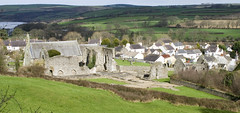
In memory of mum . . .


A rose for my mum, who died a year ago today, at about this time. Roses were her favourite flowers. Still miss you mum.

Moonbow?


I was browsing through an elderly copy of the Countryman magazine the other evening and came across a letter from someone in Australia who mentioned a Moonbow? This is apparently a lunar rainbow: "a pale, very beautiful, almost ghostly replica of the daytime rainbow. It lasted about 15 minutes before the rain finally stopped." The journal added that "readers in USA and South Africa have also seen moonbows associated with waterfalls; moonbows created by moonlight and rain have been seen by at least seven readers in England, who have reported them from the Lake District, Wales and the West Country." How bizarre. I don't suppose I'll ever see one, but I'm in the right area to look out for one now, and meanwhile, it's a lovely thought.

Wednesday, 5 March 2008

A walk round Raglan Castle

This is one of my favourite pictures from those I have taken in the past year:


I thought it was time for another Castle walk. To be honest, this would make two or even three walks - especially as I took so many photos when I stopped off there last year, on my way to stay with my friend Jude and enjoy a weekend away, visiting Ludlow Food Festival - also held in the grounds of a castle, this time - unsurprisingly - Ludlow! My photos tend to be angles which appealed to me, but have the benefit of being enlargeable if you click on them. Enjoy the link to the virtual walk at the bottom of the page for some more majestic views.

I used to have a penpal in Wales whose father was the custodian of this castle, and she and her sister have many happy memories of living nearby. But that was many, many years ago. Now it's more "official" and it is now in the hands of CADW.


Anyway, I will tell you a little bit about it and then on to the photos. William ap Thomas, the "blue knight of Gwent", fought alongside Henry V at Agincourt in 1415 and was knighted by Henry VI in 1426. He bought the castle in 1432 and along with his son, William Herbert, who became the Earl of Pembroke made improvements, including the Tudor styling we see today. During the Wars of the Roses, Herbert sided with the Yorkists, his political support for Edward IV earning him his title and paid handsomely, thus enabling him to turn Raglan into a "palace-fortress". He met his end in 1469, after Lancastrian supporters captured him at the Battle of Edgecote and put him to death. King Henry VII grew up here. Walking past the damson trees at one side of the castle, I like to think these trees might be descendents of ones which the young Henry might have scrumped!


As you can see from the remains, it was quite a "busy" place architecturally, and existed on many different levels.


Many modifications and modernizations over the generations.


The Herberts held Raglan until 1492, when the Somersets (Earls of Worcester) took possession. They also carried out considerable improvements so the castle fell in line with current fashions in dining and relaxation and in doing so, established wonderful gardens that included a number of walled terraces, a fountain, a lake, along with the wonderful Elizabethan flower beds and herb gardens.


This incredible carved fireplace was fortunately preserved at Badminton House in Gloucestershire, but is believed to have been taken from Raglan.


Alas, the English Civil War was to see the demise of Raglan, as it served many other castles (my own favourite, Corfe Castle in Dorset, amongst them). In 1642 the fifth Earl of Worcester sided with the Royalists, loaning considerable sums of money to Charles I. Unsurprisingly, this made Raglan a target for the Roundheads, and the castle was beseieged by them in June 1646, finally surrendering in August of that year. The abandonment and subsequent decay of the castle was finally halted and the building conserved by CADW and its predecessors, who took the castle into safe keeping in 1938.

This link will give you a Virtual Tour of the castle. http://www.castlewales.com/rag_tour.html


Tuesday, 4 March 2008

Edwin Muir - Orkney poet


Edwin Muir described himself thus: "I was born before the Industrial Revolution, and am now about two hundred years old. But I have skipped a hundred and fifty of them. I was really born in 1737, and till I was fourteen no time-accidents happened to me. Then in 1751 I set out from Orkney for Glasgow. When I arrived I found that it was not 1751, but 1901, and that a hundred and fifty years had been burned up in my two day's journey. But I myself was still in 1751, and remained there for a long time. All my life since I have been trying to overhaul that invisible leeway. No wonder I am obsessed with Time." (Extract from Diary 1937-39.)

He, again, was a poet I was not familiar with until a friend on Orkney included one of his poems on a forum we both go to. I discovered him again in the "Ten Twentieth-Century Poets" book I blew the dust off last week.

He was born at Deerness on Orkney in 1887 and educated at Kirkwall Burgh School. Sadly, his family lost their farm and in 1901 took the decision to move to Glasgow to seek work, where sadly, in quick succession, first his father, then his two brothers and finally his mother, died. Forced by circumstance to take any job, he struggled with a number of depressingly unpleasant jobs which affected him psychologically. He looked upon his former life in Orkney as "Eden". When he married in 1919, he and his wife moved to London, where the pair worked together on the English translations of such writers as Franz Kafka, Gerhart Hauptmann, and Heinrich Mann. He and his wife also travelled abroad to Italy, Prague, Saltzberg, Vienna and Dresden. During his lifetime he was a prolific poet, was director of the British Council in Prague and Rome, was warden of Newbattle Abbey College, which was specificially a college for working class men and in 1955 he was made Norton Professor of English at Harvard University. His most controversial work, Scott and Scotland, was published in 1936, and proclaimed that Scotland could only create a national literature by writing in English, which placed him in direct opposition to the Lallans movement of Hugh MacDiarmid. He died in 1959 and is buried at Swaffham Priory, near Cambridge.


Here is one of his poems which moves me greatly:


HORSES

Those lumbering horses in the steady plough,
On the bare field - I wonder why, just now,
They seemed terrible, so wild and strange,
Like magic power on the stony grange.

Perhaps some childish hour has come again,
When I watched fearful, through the blackening rain,
Their hooves like pistons in an ancient mill
Move up and down, yet seem as standing still.

Their conquering hooves which trod the stubble down
Were ritual that turned the fields to brown,
And their great hulks were seraphim of gold
Or mute ecstatic monsters on the mould.

And oh the rapture, when, one furrow done,
They marched broad-breasted to the sinking sun!
The light flowed off their bossy sides in flakes;
The furrows rolled behind like struggling snakes.

But when at dusk with steaming nostrils home
They came, they seemed gigantic in the gloam,
And warm and glowing with mysterious fire
That lit their smouldering bodies in the mire.

Their eyes as brilliant and as wide as night
Gleamed with a cruel apocalyptic light.
Their manes the leaping ire of the wind
Lifted with rage invisible and blind.

Ah, now it fades! it fades! and I must pine
Again for that dread country crystalline,
Where the blank field and the still-standing tree
Were bright and fearful presences to me.

Edwin Muir.

And here is a link to another poem about horses, but with quite a different message: http://www.poemhunter.com/poem/the-horses/
I am afraid I cannot find a user-friendly link where I can copy and paste this poem from.


Monday, 3 March 2008

Baa-ram-ewe . . .


One of my favourite country programmes from years gone by has always been "One Man and His Dog". Mum and I ALWAYS watched it together. For the uninitiated, it is a programme about sheepdog trialling, where the shepherd and a single dog, or a brace in some competitions, have to persuade 5 ewes to go through/round/into a series of obstacles such as a pair of gates, a shedding ring, and a pen. Points are awarded for the out-run, the lift, the gates, the cross-drive, the shedding ring (where two ewes have collars and either the ones with collars or without have to be seperated from the others), and so on. It is always filmed in the most STUNNING scenery (it's worth watching just for the views of the North Wales mountains around Lake Bala, or up in the Lake District). The BBC saw fit to drop it from their programme listings despite it having very healthy ratings, as they apparently considered it "too white and middle class". Fortunately, it has now reappeared as "Come Bye" on the wonderful new Horse & Rider channel on Sky tv.

I was fortunate to see last night's programme and I can safely say I have never seen such a stroppy, awkward, more belligerent load of sheep in my whole life. I have seen sheep assert themselves with a dog before, stamping their feet and standing their ground. I have seen awkward sheep before - "you want me to go that way? Well, I'll go THIS". You get the odd ewe that will stand her ground, but this lot, to a ewe, had been programmed (seemingly at birth) to give the dog a hard time and have the shepherd reduced to a quivering wreck, ready to be carried off by the St John's Ambulance crew because of palpitations! I think only three of the competitors even finished the course - having run out of time after the ewes refused to be penned. These ewes (obviously hand-picked, and by someone with a lifelong grudge against sheep-dog trials and their competitors) weren't just awkward, they were out to get the poor collie. Several dogs finally lost their rag with the ewes after they stood their ground and refused to move and went in and nipped - which means instant disqualification, for all it was justified in the dog's eyes! Others bit their tongues until charged by the bossiest ewe - several dogs were bowled right over, with the ewe going back for another go, and not many dogs kept their temper after that - and who can blame them. These sheep were the biggest load of bullies I have EVER seen. I should think some of those dogs were pretty battered and bruised at the end of the day. These ewes were the bullies of the Ovine race. If they'd been human they would have been the bane of the office, hard and ruthless, always having the last word, treating men like dirt and calling all the shots. You could see that the presenter, wonderful Robin Page, really felt for the shepherds - the creme de la creme of trials shepherds at that, the best in the country - and he kept saying that he had never seen such difficult sheep. From memory, they were Texal crosses. I've just Googled the following entry - apparently this was filmed during the foot and mouth restrictions and these particular sheep had to be used again and again, and what's more, they were used to being rounded up by a quad bike. Personally, I think they'd been watching Babe - you know, Baa-ram-ewe, Baa-ram,ewe . . .

Meanwhile, one of their friends had a restful time at the Three Counties Show . . .


http://www.dailymail.co.uk/pages/live/articles/showbiz/showbiznews.html?in_article_id=500578&in_page_id=1773

Sunday, 2 March 2008

The Dymock Poets


I don’t sleep well – certainly not when I have things on my mind. Then I lie awake, trying to get back to sleep, and the more I try, the more sleep evades me. My mind begins rushing around like an ill-disciplined puppy – I imagine a Jack Russell, for some reason – rushing here and there, bring back words and ideas and information like sticks for me to throw. In the middle of this night, this long, cow-coughing, wind-sighing, black-as-molasses night, it brought me a list of jobs to do. I ignored them. It bought me yew trees: I saw memories of yew trees dark, branches dancing in the breeze, a childhood book, the bleeding yew trees of Nevern, a friend sitting inside a vast yew tree at Much Marcle. The puppy got very excited then, yapping Robert Frost, and Edward Thomas, and Rupert Brooke and bringing me a huge stick with Dymock Poets written on it. Of course, sleep has now been abandoned for the night, and I have that old urge to learn, to satiate a desire to fill in the bigger picture between these names whose poetry means so much to me.

An “Access” course in English Literature which I did in 1995 introduced me, amongst other things, to the work of various poets, from Wordsworth and Keats, and culminating in the WW1 poets – though they were never called the Dymock Poets. This I only discovered recently – mentioned by my friend who took me to Much Marcle, and then on a Radio 4 programme.

The thought of a colony of poets roaming the landscape of a quiet corner of Gloucestershire, where they must have seemed very Bohemian indeed to the locals, intrigues me. They were only there a short time – arriving around 1911 and breaking up in 1914 at the start of WW1. Poet and playwright Lascelles Abercrombie, Wilfrid Gibson and American poet Robert Frost formed the core, with visits from Rupert Brooke, John Drinkwater, Eleanor Farjeon and Edward Thomas. Eleanor Farjeon had a close friendship with Edward Thomas, despite his marriage. The group were doomed never to reform – Rupert Brooke died from septicaemia in 1915 (strangely enough, like Lord Caernarvon, from an infected mosquito bite), and Edward Thomas was killed in action at Arras in 1917. These two were also known as the Georgian poets, along with Masefield, Sassoon, Masefield, Andrew Young, Robert Graves, Walter de la Mare and others.

They published their own poetry magazine, New Numbers, the first issue was dated February 1914; Gibson published two volumes of poetry early in 1914 – Fires and Borderlands. Edward Thomas published his book In Pursuit of Spring in April the same year. Originally a prose writer, Robert Frost encouraged Edward Thomas to write poetry instead, and his own book of poems, North of Boston, was published in May that year. A second issue of New Numbers was brought out in April, and a third in the August of 1914. By the end of the year, Rupert Brooke was serving his country at War. Drinkwater and Abercrombie were involved in writing and producing plays and Drinkwater’s poetry was published – a book called Swords and Ploughshares – in 1915. The issues of New Numbers (there were only ever 4), were posted out from the tiny village post office at Dymock.

This poem from Wilfrid Gibson (who I believe lived in the cottage called the Old Nail Shop), is a very fitting end to this Dymock meander and to their time together:

...in the cosy cream washed living room
Of the Old Nail Shop, we all talked and laughed -
We sat there in the lamplight, while the day
Died from rose-latticed casements, and the plovers
Called over the low meadows, till the owls
Answered them from the elms, we sat and talked...
'Twas in July
On nineteen fourteen that we talked
Then August brought the war and scattered us.
The figures dissolve. The echoes die away. Ou sont les neiges d'antan? Now the Dymock daffodils, albeit thinner ranked than of yore, nod sagely silent in the breeze, a little fugitive sunlight warms the young bones of a new spring's generation...the lambs skip, the guns are spiked, old tragedies lie crumbling below encrusting coats of tear-absorbing moss.

An excellent link is: http://www.encyclopedia.com/doc/1G1-72986213.html

Andrew Young, poetry


I may have mentioned once that only when I left school at 16 did my proper education begin, because then I learned about the things which really interested me. When I was 20 I enrolled in a correspondence course (English Literature) intending to further my education and become a journalist. Well, I never finished the course, and I never became a journalist, but I have never lost my love of literature, nor my love of writing. I was going through my poetry books recently and came across “Ten Twentieth-century Poets” by Maurice Wollman, last printing 1972. Some of the poems in it are firm favourites of mine, others I am only encountering properly now, as the book sits by my computer keyboard, opened whilst I wait for the broadband connection to actually connect . . .

In this way, I have, belatedly, discovered Andrew Young. He was born in 1885 and was still alive at the time this book was published (though long dead now, one assumes). Born in Elgin, Scotland, he became a Canon of Chichester Cathedral in 1948, and Vicar of Stonegate, Sussex, in 1941. He wrote with the air of someone who spent long hours just standing and observing nature, a real countryman, whose knowledge came from intimate acquaintance with the outdoors in all weathers, at every time of year. I hope you will enjoy him with me for a while:

MARCH HARES


I made myself as a tree,

No withered leaf twirling on me;

No, not a bird that stirred my boughs,

As looking out from wizard brows

I watched those lithe and lovely forms

That raised the leaves in storms.

I watched them leap and run,

Their bodies hollowed in the sun

To thin transparency,

That I could clearly see

The shallow colour of their blood

Joyous in love’s full flood.

I was content enough,

Watching that serious game of love,

That happy hunting in the wood

Where the pursuer was the more pursued,

To stand in breathless hush

With no more life myself than tree or bush.


This is SO beautiful and speaks to me of the ancient hollow-ways I too have known:


THE LANE

Years and years and man’s thoughtful foot,

Drip and guttering rains and mute

Shrinkage of snows, and shaggy-hoofed

Horse have sunk this lane tree-roofed

Now patched with blossoming elder,

Wayfaring-tree and guelder;

Lane that eases the sharp-scarped hill

Winding the slope with leisurely will.

Foot of Briton, formal Roman,

Saxon and Dane and Sussex yeoman

Have delved it deep as river-bed,

Till I walk wading to my head

In air so close and hot

And by the wind forgot,

It seems to me that in this place

The earth is breathing on my face.

Here I loiter a lost hour,

Listen to bird, look on a flower.

What will be left when I am gone?

A trodden root, a loosened stone

And by the blackthorn caught

Some gossamery thought

Of thankfulness to those dead bones

That knit hills closer than loose stones.


Just one more perhaps, as I used to live in Wiltshire and love the downland and the larks singing:


WILTSHIRE DOWNS


The cuckoo’s double note

Loosened like bubbles from a drowning throat

Floats through the air

In mockery of pipit, lark and stare.

The stable-boys thud by

Their horses slinging divots in the sky

And with bright hooves

Printing the sodden turf with lucky grooves.

As still as a windhover

A shepherd in his flapping coat leans over

His tall sheep-crook

And shearlings, tegs and yoes cons like a book.

And one tree-crowned long barrow

Stretched like a sow that has brought forth her farrow

Hides a king’s bones

Lying like broken sticks among the stones.

Saturday, 1 March 2008

St David's Day . . .

I know, I know. There should have been a long post about St David. But I 'm not feeling 100% today, and Leanne over at Somerset Seasons has done this post so well, I'll give you the link and let you read hers!

http://www.somersetseasons.blogspot.com/

Adlestrop - Edward Thomas


Edward Thomas (1878-1917)

Adlestrop


Yes, I remember Adlestrop --
The name, because one afternoon
Of heat the express-train drew up there
Unwontedly. It was late June.

The steam hissed. Someone cleared his throat.
No one left and no one came
On the bare platform. What I saw
Was Adlestrop -- only the name

And willows, willow-herb, and grass,
And meadowsweet, and haycocks dry,
No whit less still and lonely fair
Than the high cloudlets in the sky.

And for that minute a blackbird sang
Close by, and round him, mistier,
Farther and farther, all the birds
Of Oxfordshire and Gloucestershire.

I love Edward Thomas's poems. Returning one day from a far-away place, I drove past the turning to Adlestrop. I had a long way to go. It was getting late. I often wish I'd stopped and explored . . .