Saturday, 22 August 2009

SCREAMING LOUDLY


I don't believe this - Google Blogger is giving me so much trouble accessing this account, and I STILL can't change my old e-mail addy to the new one as since I have had to start another blog - www.Codlinsandcream2.blogspot.com, it says my new e-mail addy is already taken.

Please, if you come here, follow the link above to my new blog as I don't know whether I will get back in here ever again! My apologies for being such an inept blogger . . .

The same applies to BB's Nature Notes, my other blog, which I have decided to amalgamate back into this one.

Sunday, 16 August 2009

Today's car boot sale

K and I went to the car boot sale this morning and struck lucky with several items. I found another copy of a book I already have, which worked out well as a gift for a friend and I found a seperate book for 50p which just HAD to come home with me. Reading it on the way home, I wanted to make just about every recipe in it, so I reckon it was a very good buy. I spent this afternoon baking and tried out the Carrot and Orange Cake from the new book (pictured below). I shall report back, with pics and the recipe.


K found these dinky little hand-turned salt and pepper pots for £1. He appreciates anything hand-made from wood and just had to have these - they must have been SO fiddly to make. The tops screw off and the salt and pepper can be shaken through the S and P letters. They are on a slanting base so they lean away a little.


The gorgeous basket was one I fell in love with. OK, I later found it had a Made in China sticker on it, but is craftsmanship all the same and it is JUST what I need for my overflow of sewing/crafting/knitting bits and pieces. We gave it a good scrub off with a very weak bleach solution, but the blue is paint and not mould I am glad to report.

I didn't get this little jug today, and can't remember if I have mentioned it. It cost £4 few weeks back, but was so unusual, with its lid like a wig with flowers on, and I reckon it dates from around the early Victorian period. It has a couple of chips, but I will forgive it those because it has such charm and character otherwise.

Friday, 14 August 2009

Llanfynydd Show

This little steam engine was made from scratch by our neighbour. The next five tractors beyond it down the line also belong to him and have been/are being restored by him.
The top four are his . . .
I think I remember rightly being told that this green tractor was a 1940s vintage.

Entries in the local class (from the parish) under 13.2hh. This Section A foal not only won its class but I believe was the local champion too.

A magnificent set of horns on one of the Jacob rams.

I am so tempted to say that this is the sheep-wrestling class, but no, it is just a bevy of sheep being shown, for some reason, without halters . . . There was lots of fun when one took it into its head to run away!

The weather looked threatening, but the rain held off. Sheep pens and judging at the bottom of the pic. It's interesting to see our neighbouring parish from a different angle.

This was SOME bull. I'm not a bovine expert, but it looks well made to me and hey, he's got the red rosette!

This is my neighbour's lovely cob mare who won her class.

These love spoons are made by Mr Martin from Llanfynydd. I think they are absolutely superb.
A close-up of some of the spoons.

The lighter spoon on the left is all made from one piece of wood, carefully worked at until the balls in the handle run free and turn, and each link of the chain is carefully carved. I think I will have to do a special post about love-spoons when I have caught up with myself.

Some of the entries in the sewn handicrafts competitions.

Entries in the jewellery making class.

Some of the entries in the flower classes - this one must have been unusual container or something, hence the wellies.

Now that's what you CALL onions. I think the same chap got first, second AND third!, though that was hardly surprising.

This would be the Bara Brith end of the cake competitions. They look pretty good don't they? Just the thing to go down with a mug of tea though to be honest, there were a few interested flies about . . ..

These are the entries for the Longest Thistle competition, which always makes me smile. I could have easily won Longest Dock plant last year . . .

Sunday, 9 August 2009

Viking Re-enactment Day

This is a wonderful multi-period permanent site at Cranborne. There are wonderful houses from past period including an Iron Age Round House, a Roman building, a Grubenhaus (or SFB - Sunken Feature Building as they are spoken of in archaeological reports), and a wonderful turf-roofed Earth-house. Here is a link to a site about the entire project, including lots of photographs and better views than I could provide.


Technology as it used to be in the fork of a pole lathe. Here a piece of wood is being prepared for turning. My husband and dear friend Gay looking on.
Isn't this Earth-house wonderful? I can't pin it down to a particular period (their web page makes it a combination of Neolithic wood henge and Iron Age roundhouse), but I will say that the remains of circles of huge (tree-sized) post holes have been found across the country - the sites I remember, being Mount Pleasant in Dorset, and also the Greyhound Yard excavation in Dorchester - where post holes are painted on to the concrete in the Waitrose basement car park . . . BUT these were both henge monuments - rather than buildings with huge posts like this. It's an amazing place inside.

The lady is holding a "bull roarer" which makes one heck of a noise when swung round the head (as it is in the picture below). It is a means of communicating over long distances, and has a very venerable history, dating back to Paleolithic times. It is also known as a rhombus or turndun. Follow the link for the appropriate Wikipedia page and another link to the Pitt-Rivers museum.

The interior of the wonderful Earth House (very Lord of the Rings from the outside).

Above and below: A selection of the musical instruments being displayed. Some were for sale, but a tad expensive for our pockets!

Cooking was authentic and the lid looks as if it has seen much use, and over hotter fires than this one!

There were several staged battles during the day, then the children were invited in to have a go!

Flint nodules as they are when they are dug out of the ground. Useful for building (see Knowlton entry) as well
I think this wonderful wooden chest is going to be created by my husband over the winter months . . . We just need to get the hinges made up by a local blacksmith.

Tablet weaving - have put the feelers out for my husband to make me the tablets from leather, or else buy me some for Christmas. Meanwhile I have a very small loom which I fund at a car boot sale for £1, which I am going to learn to weave on.

The herb plot by the Roman house.

Net making. This man was very interesting to talk to and I came away thinking, I can make haynets now . . . ! (He was making fishing nets).

The SFB. That is, Sunken Feature Building or Grubenhaus. Very Anglo-Saxon and the sunken floor is usually considered a feature that enabled wool to be stored at ambient temperature so it didn't get too dry to spin. The two hammocks contain fleece . . .

Splitting chestnut logs for shingles for the roof of the latest building, the huge Viking longhouse.


Saturday, 8 August 2009

You'd know her if you saw her!

This has been copied from Genuki Devon's list of Absconders 1800 - 1821:

Caution
Whereas, Elizabeth, the Wife of Ambrose Shere, of Cullompton, Devon, did on the 29th day of August last, (being the Twentieth time), Elope from her said Husband without any other provocation than her own procuring, and that she thought her said Husband was too old to supply her desires (being 78) and she being lost to duty and virtue, and also insensible to shame and brutality, and her adviser hath occasioned her disgrace and ruin:- This is to caution all persons not to trust her on my account, as all such debt or debts will not be paid by me. And the said Elizabeth Shere may assume some other Name, it is therefore proper to observe that she is about 34 years of age, short in stature, thin in face, flattish nose, watery eyes, bad teeth, squints a little and cannot read or sew without spectacles; she continued about Cullompton until the 14th September, and then left the Town.
Witness my hand, Ambrose Shere.
Cullompton, 9th October, 1821.

I could make a wicked comment about women marrying men old enough to be their grandfather and expecting a good sex life, but I shall refrain . . .

or

Trewman's Exeter Flying Post, Thursday, August 5, 1813; Issue 2500 - Gale Document Number Y3200653002

Whereas, Susannah Huxtable, the wife of Anthony Huxtable, farmer of Instow, in the county of Devon, left her home and family on Wednesday the 14th instant, under the influence of a mental affection, and has not been since been heard of.
The said Susannah Huxtable is about 30 years of age, of a middle stature in height, thin habit; wore away a dark cloth pelisse, trimmed with black velvet and black silk bonnet. Has lately had all her hair cut off. It is hoped that all head borough and parish officers will cause such search to be made as will insure notice of her safety to her afflicted family, who will gladly pay all reasonable expenses attendant on her conveyance to the parish of Instow, or send for her upon receiving any information where she may be found.
Dated Instow, July 30th, 1813.

Do you think that they shaved her hair off in the vain hope of restoring her addled wits?

or him . . .

Trewman's Exeter Flying Post, Thursday, September 29, 1814; Issue 2560 - Gale Document Number Y3200653591

Whereas William Pittwood, of the parish of Ringsash, near Chulmleigh, Devon, did on Friday last, the 18th of this instant, September, leave his brother's house without any provocation, and has not since been heard of, this is to give notice, that whoever may have seen the said William Pittwood, or can give any information of him, so as he may be found, shall receive a handsome Reward, from his brother, John Pittwood, of Ringsash aforesaid.
William Pittwood is 49 years of age, light hair, fair complexion, about 5 feet 6 inches high, is lame in his left pinbone and limps in his walk. He wore a nankeen jacket, corduroy breeches and lightish colour waistcoat, laced shoes and worsted stockings. Is supposed by his friends to be a little touched in his mind.

Perhaps his friends were right!

or

Trewman's Exeter Flying Post, Thursday, July 4, 1811; Issue 2387 - Gale Document Number Y3200651949

To the Public
On June 29th, 1811, John, the Son of George Moase, Tanner, of the parish of Petrockstow, near Hatherleigh, Devon, went from his father's house, in a state of insanity, the cause of it is supposed to be an intense application to the study of mechanism. He is 19 years of age, about five feet eight inches high, dark hair, thin features and of a pale complexion. He wore off a light nankeen jacket, calf-skin waistcoat an old hat, a red silk handkerchief, dark corduroy breeches, worsted stockings, nailed shoes, and a canvas apron, dyed tan-colour. He is perfectly inoffensive to every one, and during the intervals of reason, remarkably pious and conscientious. It is therefore hoped, that all persons who shall meet with him, will treat him with kindness and compassion, and whoever will conduct him back to his father, or give information where he may be found, shall be handsomely rewarded.

I hope they found him, poor lad . . .

This is a rich source of information about ordinary people, who got fed up with their lot, or had breakdowns or whatever. Abandoned husbands lost no time in saying, she's nothing to do with me, I don't want her debts. Others were genuinely concerned about family members wandering off. Others sought to warn other people about debtors, horse-thieves or whoever, roaming the roads lest they pass themselves off as ordinary mortals . . . .


The full transcription can be read HERE.

Thursday, 6 August 2009

Knowlton Church and Henge Monument

Scabious dancing in the breeze on the banks of Knowlton henge monument.


We visited Knowlton church and henge on our way to the Viking Re-enactment at Cranborne on the first day of our recent holiday. The henge monument was brimming with beautiful wild flowers of the chalklands, and so I will catalogue those on BB's nature notes in due course.

Cue creepy music! I was just looking up information on the history of this site and came across a paranormal investigation by Southern Paranormal UK . . . I have to confess that in daylight I felt nothing at all, but was fascinated by the number of yew trees in the area, and also along the roadside between Knowlton and Cranborne (which is about 2 miles beyond Knowlton). I don't know what to make of the "mist" in their photographs or the feelings they felt in the church, so I shall leave you to make your own minds up.

The church in the centre of this wonderful henge monument was "added" in the 12th century and improved in the 15th. Obviously this "pagan" site had to have the Church's stamp upon it to legalize worship there. In Peter Knight's book "Ancient Stones of Dorset", he draws on other writings to suggest that there was once a circle of standing stones within the henge monument but that these were broken up and incorporated in the fabric of the church. It was also recorded that when the local hundreds estates met, it would be at Knowlton, so it has obviously been long associated with such gatherings.

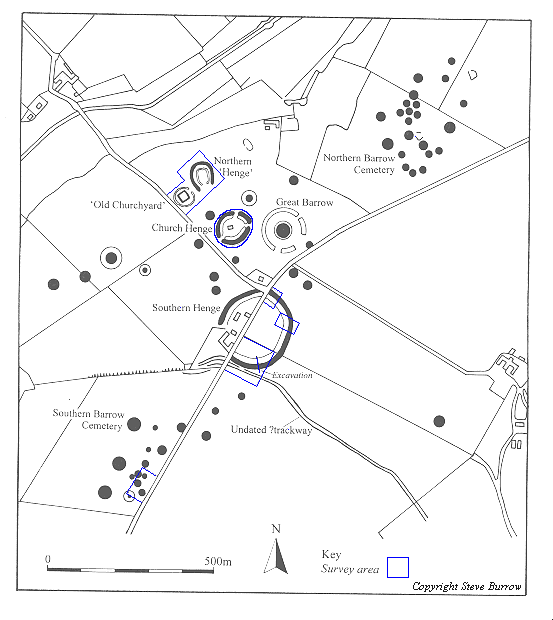
However, the surveying and excavations carried out by Bournemouth University show that this henge was part of a much larger complex and one of three henge monuments in association with barrow cemeteries. How I wish I had known that before we stopped there, but it was rather a spur of the moment decision, taken when I realized we would be driving near it! Here is a link to the Bournemouth University's research pages, which may be of further interest.


The church itself is built incorporating flint nodules (see top of page) - a design familiar to Hampshire and Dorset folk. Charlton Marshall, I believe, has a particularly fine example, where there is a chequerboard pattern. Yet when we lived in Lytchett Matravers and used to drive past it regularly, we never stopped for a closer look!

Much of the tower still remains. I have been viewing the building with an eye to see which parts of it might be shattered standing stones . . . the doorways are possible candidates, though I suspect large lumps of stone would more likely be in the foundations of the church. I don't know if the brown sandstone type stone is what has been called "moorstone" by some. It appears to be rich in iron and possibly responsible for some of the local "energies"?

One of the earthen banks of the henge. There are three entrances, and at the Northern end, there are two yew trees forming a further "entrance". Other yew trees are nearby, and along the road northwards, and I wonder whether these were the remains of an ancient yew forest - bearing in mind how yew trees can regenerate from dieing remains of very aged trees - or perhaps a sacred grove? One never knows whether to think pagan or "romanticised" thoughts or scientific ones when considering the landscape, but the archaeologist in me insists "scientific" . . . I know that there is a good stand of yew trees on one side of Hambledon Hill and quite a prolific yew woodland at "Great Yews" near Bodenham/Nunton (just outside Salisbury).

The two yew trees at the North end of the monument. Note, however, that they do NOT align with any of the actual entrances through the henge banks, and my husband tells me that they are probably one and the same tree and one is literally an offshoot of the other's root system so they are not deliberately "paired" in any sense.

There was a village associated with the church in until Medieval times, when the Black Death wiped out the parishioners around 1485. Peter Knight records that earth energies are to be felt here, and that it is a complex site. Holding ones hands against the buttress has resulted in an off-balance feeling pulling the body to the left. I wish I had remembered this at the time (I thought it was the doorway where I picked up nothing).

Wednesday, 5 August 2009

Where's Snowy?

I could hear him. He was in the kitchen somewhere. Was he in the cupboard? No. Was he on a chair? No. Was he under the sink? No. I knew he was there somewhere.


I hunted high and low, and then I found him . . .


Snug as a bug in a rug! As you can see, his ear is healing nicely, although the dissolving stitches seem to be taking their time as it's over three weeks since his operation now.

Yesterday was cool, wet and miserable. I made a lovely Cottage Loaf and some Spicy Bean soup. Today we are back to hot sunshine, so I had better freeze the rest of that soup . . .


Spicy Bean Soup

1 onion, chopped and fried gently in a little olive oil.
Cut 3 rashers bacon into small pieces and add to pan and fry gently.
Add a tin of chopped tomatoes, whatever vegetables you have about the place and a pint of stock (I used a good veggie stock cube and a heaped teaspoon of veggie Bouillon). Shake of salt and pepper and then add a tin of spicy mixed beans. I also added a good slosh of my home-made brown sauce. Simmer until veg cooked and then add a handful or two of pasta and cook till pasta done. YUMMY. You can stick a spoon upright in this soup!

The cottage loaf was 1lb of seeded wholewheat flour and 1/2 lb strong white mix. As my daughter said, one slice of that sees you through till lunchtime . . .

Tuesday, 4 August 2009

Farleigh Hungerford Castle

As we were travelling down to Hampshire (via North Dorset), we came upon Farleigh Hungerford Castle, and of course, couldn't resist stopping to explore. It covers quite a considerable site, and the castle chapel was unsurprisingly incorporated within the castle walls. Because of this, much of the interior of the church is preserved to show how it would have looked when the castle was last inhabited. The castle has quite a colourful history. Originally a manor house of the Montfort family, the manor was known as Farleigh Montfort and in the hands of Reginald de Montfort until about 1350, when he sold it to one of Edward III's soldiers, and in turn it was sold a generation later to Sir Thomas de Hungerford, who promptly changed its name to Farleigh Hungerford.

Around 1370-80, the castle was fortified and crenellated (without licence - this being granted retrospectively by the King in 1381. Who says retrospective planning is a new thing?!) Some 50 years later, the barbican and polyganol outer ward were added by Sir Walter Hungerford, then Speaker of the House of Commons. In the early 15th century his son - another Walter - enclosed the parish church of St Leonard's to use as his chapel, building another church for the parishioners in the village.

Sadly, war did for the Hungerford family and the castle passed to Richard, Duke of Gloucester (later Richard III) and thence to the Duke of Clarence and here was born Margaret Pole, 8th Countess of Salisbury (whose mother was Isabella Neville, and whose grandfather was Warwick the Kingmaker). Unfortunately she was to be beheaded at the behest of Henry VIII . . . (Don't you just LOVE English history?!)

After the Battle of Bosworth, Henry VII gave Farleigh to Walter Hungerford, grandson of Robert. I think you could describe him as a complex personality. Although he married three times, it would seem he was more of a man's man, if you get my meaning, and kept his third wife under lock and key in one of the towers. Fortunately for her, Walter got his comeuppance and was accused of treason and "unnatural vice" and was consequently executed.

The Civil War had true meaning for Farleigh Hungerford, since two Hungerford brothers were fighting against one another, but the Royalist submitted the castle to his Parliamentarian brother without a fight. Much of the damage to the castle was carried out by a subsequent family, the Houltons, who decided they would take various fixtures and fittings (including the panelling and carved beams) off to their main residence in Trowbridge. Many thanks to the Wikipedia page where the above information was ruthlessly plundered.


The former Priest's house.

This building is completely unchanged, although internally it now houses an interesting little museum rather than a Priest!


This gargoyle on the right reminded me of one of the hounds in the heraldic shield - perhaps it's the hair which looks like ears!

If you double click on this picture you should be able to read it more easily. A fascinating little piece which was found in the Castle ditch - another victim of a Puritan mind and thrown out as being idolatorous . . .

I felt like we were stepping back in time here. Yet another example of how colourful churches once were, Before The War (Civil War that is), and then all those Puritan minds saw idolatory and shame in anything with a vestige of colour or design. In Salisbury Cathedral last week many of the effigies of past Lords and even Kings, had been brutilized and were sans noses or any projecting parts, or had initials dug into their faces. To think we complain about lack of respect these days - it would seem it was ever thus. There are some Hungerford lords interred at Salisbury too . . .


How vivid and colourful these tombs must have been when first erected.

I am not sure about that light - it was overall gloomy down there . . . Cue ghostly music! Note the two little babies in the tiny lead coffins . . .

The towers were pretty huge - it's amazing they're still standing.

Monday, 3 August 2009

Who am I? in 7 words tag . . .


Mags over at Life in the Preseli Hills has tagged me t describe myself in just 7 words. I shall try and rise to the challenge . . .

1. Firstly how can I say 'Doesn't suffer fools gladly' in one word which doesn't make me sound sharp, condescending, judgemental or intolerant? Hmmm. Aries will have to do, as that is one of the Aries attributes, although my Scorpio husband has bucketfuls of it too.

2. Intuitive. I am lucky in that I can tell what a person is like instantly - they don't' have to say a word, I just KNOW. I have only been wrong twice in my life and they were both very very shy people who were literally unreadable. The big drawback to being so intuitive is that if I really take a dislike to someone, I find it very difficult hiding my dislike . . .

3. Honest. Brutally so on occasion. If you ask, "Does my bum look big in this?" well, I will just have to tell you, yes it does! But then, I don't ever try and curry flavour by flattering people and only rarely will I tell a lie, and then I tell myself it is a FIB. What you see is what you get with me. Another Aries trait I fear . . .

4. Creative. I love to write, draw, sew and make nice things. I love to bake and make jams and chutneys and try all sorts of obscure things that other people wouldn't waste their time on. It satisfies me, especially the writing. I suppose in a way it is trying to boost self-confidence, though not an intentional thought, but it IS nice when someone compliments you.

5. Country-loving. I used a hyphen, so hope that's not cheating! I have always loved anything connected with the countryside and nature. I was interested in wild flowers by the time I was 6 and got The Observer's Book of Wild Flowers. Others followed - Birds, Birds' Eggs, Butterflies and Moths, Pond Life, plus the inevitable Horses and Ponies, Dogs etc. I would rather be in the countryside than anywhere, preferably as far away from other people as possible, though there are times when I need people too. I am a sucker for anything (especially books) with "Country" in the title. If it's a recipe book then it can be "Country" or "Farmhouse".

6. Bibliophile. I simply CANNOT live without books. I have thousands. I've been like this all my life - ever since I learned to read in infant's school and actually STOLE a book because we didn't have books at home and I was SO desperate to read. I began collecting antiquarian books on horses when I started work at 16. I still collect them. And books on history. And Archaelogy. And the countryside. And natural history. And cookery. And literature. And literary biographies. And you should never start a sentence with And . . .

7. Finally, I am a Softee. I seem to attract and "collect" lame ducks. I don't like to hurt people's feelings. I hate to say "no". It's probably part and parcel of being intuitive (and more besides) because I can always pick up on other people's emotions and need for friendship.

I won't tag anyone, but if you want to join in, let me know that you have.

Take two little girls!

I will go back a week or so and share with you a photo of two happy little girls demonstrating that churches are for playing hide and seek in. Honest! Keith and I had a lovely time at GTM's house, and were shown round the village. They, in turn, helped me have one box less of books in our house, so I hope they are enjoying them.


I am SO envious of her neat and tidy veg plot - I have returned home to green mayhem and a lawn that thinks it's a hay meadow!


My husband's dream house . . .

Saturday, 1 August 2009

A Country Harvest

I found this book in one of the Ringwood charity shops and the moment I set eyes on it, I knew it would be coming home with me. It is subtitled "An illustrated Guide to Herbs and Wild Plants, including delicious recipes, herbal remedies and beauty treatments", by Pamela Michael. Never was £2.50 better spent.

It's not quite time for Sloes just yet, but I loved the name of this recipe so I thought I would share it with you and you can make sure of locating the best sloe bushes in your area in good time to make this in early autumn. You can have a practice run with whatever soft fruits you have in the garden or freezer right now:

WILD KISSEL WITH SLOES

Early Autumn

Kissel is made with any red or dark red summer fruits - raspberries, cherries or blackcurrants, either mixed together or by themselves. The juice is always thickened with arrowroot and should be sweet and well-flavoured. The dark, strongly flavoured little hedgerow fruits make a very good version of this traditional Austrian dish. You can omit the red wine, but it does improve the flavour.

Serves 6

1/4 litre/ 1 1/4 cups / 1/2 pint sloes
Ditto amount of blackberries
1/2 litre / 2 1/2 cups / 1 pint elderberries
Ditto amount of water
300g / 1 1/2 cups / 3/4lb sugar, or 1/2lb honey
1 orange
1 level tablespoon arrowroot
3-4 tablespoons red wine
a little extra sugar

Wash the fruit and strip away all the stalks, put the mixed fruits into a large saucepan with water and sugar, or honey. Bring slowly to the boil and stir until the sugar or honey has melted, then cover and simmer gently for 10-15 mins. Pour into a basin and stand until cold.

Pare the rind from the orange and squeeze out the juice. Mix the arrowroot and strained orange juice together in a cup. Strain the juice from the stewed fruits into a saucepan, add the orange rind and wine and bring slowly to the boil. Add the slaked arrowroot and stir constantly while the juice thickens and clears, then draw off the heat. Add the stewed fruits and pour into a bowl. Serve cool, but not chilled.