Do you remember when "Made in England" was on just about everything we bought? It was a byword for quality. I'm trying hard to think of anything at the cheaper end of the market which is still Made In England, particularly if it is a garment, but it seems that everything comes in from the Far East sweatshops these days. In fact, everything seems to be farmed out, from food to utilities. Britain has forgotten that it is an Island, and as such, vulnerable in times of duress.
Indeed, back in 1967/68, pride in our country and a motivation to reduce the Government Debt (who would help them out these days?!!!) resulted in a short-lived campaign to work an extra half hour a day for no pay to increase productivity. The slogan was "I'm Backing Britain". Here in Wales of course, it was "I'm Backing Wales" . . . It was started by 5 secretaries in Surbiton, who were working for Colt Ventilation and Heating and you can read all the details on the Wikipedia entry.
Back in the 1930s, Dorothy Hartley was travelling the countryside chronicling the skills and crafts which were recorded faithfully in her book "Made in England", first published in 1939. Her book is divided into crafts associated with Wood; Straw, Reed, Grass and Willow; Stone; Metal; Bricks and Pottery; Leather and Horn and Wool and Feathers. Let me share an extract with you:
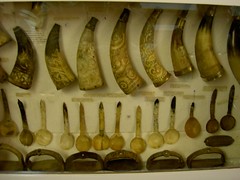
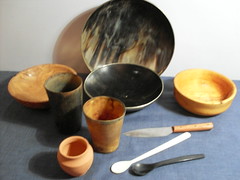
"One of the most beautiful things I ever saw of English make was a black oak table, polished with beeswax, upon which stood twelve slender black horn tumblers. They fluted upwards, from ebony to creamy white, and there were black and white horn-handled knives to match - simple, practical, and modern, yet as old as the hills. It is a great pity that the new composition materials, from which so many various things may be fashioned, should have helped to reduce the output of the genuine horn goblet. There is even less 'apparatus' needed to form goblets than spoons - a saw, lathe, and polishing buffs are all that is required.
Apart from the decorative value, travellers find horn light in weight and often more effective for use than metal or glass. In this connection I remember a very English incident in a small horn factory in Gloucestershire. A workman who had been in trade from boyhood, 'and his father before him,' said that his grandfather, 'before that,' had a busy time 'a few years ago' when he (the grandfather) 'got a sudden rush of orders for medicine glasses for the Crimean War'.
Because as soon as the doctors arrived abroad all the medicine glasses were found broken in the knapsacks, so then 'all army medicine glasses had to be made of horn'. It was 'a great rush of work in that small place in those days!' I remember I had spent a happy afternoon in that country workshop, and now the place was very quiet, the workers had gone home, a bee drifting in through the open door zoomed its way across and out through a broken window. On the odd tools and the worn benches, the dust of the day's work and the fluff from the polishing lathes was drifting down.
I remember how the workman stooped slowly, and hunting and rooting in an old oak bin under his bench, produced one of these old glasses for me. He wiped it, and stood it down on the bench. It was 3 inches deep, by about 2 inches in diameter, very dusty. He looked at it reminiscently, 'Very clear horn, these medicine glasses had to be - this one's darkish, expect that's why it got chucked out; it's been there ever since the Crimea . . .'
He chucked it back into the box, together with a short shoe-horn, a snuff box that had warped, and something new that looked as if it might be a piece of aeroplane fitment. The horn, and the workman, were the same: only the wars change." ("Made in England": Dorothy Hartley, 1939, Eyre Methuen.
We still use the old-fashioned bone-handled table knives, a bone-handled carving knife, and I have two very old bone spoons (one Scottish) which are a joy to touch. It is good to find out that items are still being made from horn and its use has not died out entirely.
In case you are interested, the following link is excellent, and horn spoons and other items are still being made and sold, though I suspect there is little British horn now that cattle are generally disbudded as calves. And that link calls up another forgotten skill - the traditional Umbrella Maker . . .