Tuesday, 31 March 2009

The long way round

We had to take our car for its first MoT last week, and went the most delightful scenic route both ways, up over the mynydd. It was raining on the way out so I couldn't take photos of the beautiful Saanan valley, but I made my husband stop on the way back over Llanybydder mynydd for a photo session. I spotted this small standing stone beside the road and yelled, "Stop!"

Below: As you can see, it was quite diddy, but perhaps there is more hidden beneath the peat and tussock grass . . .


On the very top of Llanybydder Mountain, you can see the steeply banked trackways of old farmsteads, against the backdrop of mile upon mile of Forestry Commission pines. This is Brechfa Forest. They have one stage of the World (Car) Rally Championships here each year.

And when the logging company has been in . . .

The shabby little Village Hall, c. 1920ish I would think.


The little church of Llanfihangle-Rhos-y-Corn.


Inside it is a very plain and simple place of worship.

What a pretty pulpit with its sunflower motif.

There was a lovely maze put in the adjacent field, and as I walked around it, in reflection, I began to understand mazes - you couldn't cut corners or step across, you had to keep on to the end, nose to the grindstone, so to speak, in quiet contemplation . . .

J.J. with a date of 1869.

I wonder who M.E. was? I have a feeling they were in memory of children.
Looking back in the direction of home. Our valley begins with the last swell of hill.

A 'modernized' cottage snuggled down in the valley below.

The road is just ever so slightly zig-zag! The bend after this almost disappears up its own . . . You get the picture?!

Saturday, 28 March 2009

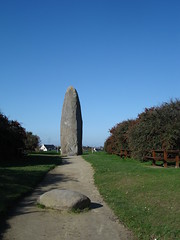
Archaeology - the 67 foot tall menhir . . .


I found my birthday present this week (early!) It was going to be something gardening-orientated, then my darling husband dragged me into the excellent 2nd hand book shop in Llandeilo and my fate was sealed, as I came out with Julian Cope's The Megalithic European, which I had seen in Ottakers when it first came out, but at £35 was out of my budget then. Here it was remaindered and only £20, so it didn't hurt so much!

Of course, I wish I had seen The Modern Antiquarian now - especially as the cheapest price I can source it at is £50 plus p&p. Ah well, I shall pray that it turns up at a car boot sale as I shall fight for it!

Every evening I pick this wonderful book up, read a bit more, look through the gazeteer - which is AMAZING. Menhirs and burial chambers from across Europe. I have visited many archaeological sites in Britain, from Aberdeenshire down to Devon, and of course, here in Wales, and also in Ireland. I would love to go to Britanny though, to the concentration of fabulous monuments at Carnac. The amazing stone rows at Kermario which remind me so strongly of the little echoes of them which survive on Dartmoor (Merrivale and Drizzlecomb), and the wonderful jewel in the crown that is Gavr'inis, with its richly-carved stones, reminiscent (slightly) of those at Newgrange in Ireland, which I have seen in the flesh. I can remember doing an essay on the artwork on this at Uni and my conclusion (then) was that it was associated with the coming of agriculture. I'd like to revisit the topic now . . .


And the 67 foot menhir? That would be the Grand Menhir Brise. Weighing in at 300 tons, and sadly broken on the ground in several gigantic pieces, there is no evidence that this ever stood - though it would need to have been buried in the ground roughly a third of its length. The fact that it exists at all, broken or no, says a lot about the society which brought it to that place. There are other massive menhirs amongst this concentration of truly superb archaeology. The Table de Marchands and Er Grah, less than 100 metres away, have sections of yet another huge menhir as their capstones - this menhir probably stood on the site of Er Grah according to Julian Copes and a third section of this standing stone is incorporated into the tomb at Gavr'inis. One might speculate that the reason for doing this can be one of several - veneration for the previous monument, although it would appear that its ritual use had changed over time, causing the menhir to be incorporated in the new burial megaliths; deliberate destruction - perhaps following the introduction of different religious beliefs, or just sheer practicality - menhir falls over, breaks, and a lot of man hours saved having to quarry and move stone from elsewhere.

This amazing monolith was somehow moved over 2 and a half miles from its native quarry. This was 6000 years ago and whoever was in control of causing this concentration of prehistoric building, was a very powerful leader indeed.

Photographs courtesty of contributors to Creative Commons Search.

Wednesday, 25 March 2009

Castell Coch Part II

The cowman (!) Next Door once took his girlfriend to Castell Coch for an afternoon out. He reported back that it was "very small" and "nothing special" and a waste of money . . . The old saying about casting pearls before swine springs to mind!

I have to go out now so will return later and add more information beneath the pictures. Enjoy!

The truly magnificent fireplace in the Banquetting Hall.

The Drawing Room walls are painted with scenes from Aesop's Fables. These were executed following Burges' death in 1881 and typical of the Aesthetic movement design then employed when the Master's guiding hand was gone. If you double-click on this you will see that the monkey left, has wonderful Victorian whiskers, and that there is a little frog in the middle with a quack medicine bottle!

The fireplace with the figures of the Three Fates above it, designed by William Burges and executed (carved) by Thomas Nicholls.

Painted panels surrounded us, with detailed botanical studies.


Foxgloves and other wild flowers painted in the panelling.


A close up of the detailed wall painting in the Drawing Room. This is JUST up my street - LOVE it. Hollyhocks are US!


A corner of Lord Bute's bedroom. The bed was based on a design by Viollet-de-Duc and was made from copper-plated cast iron railing held together by elaborately knotted ropework. The feet splay out in a very Moorish design and I wish I'd taken a photo of them now!

Wouldn't you jut LOVE a bed like this? The mattress looked good and lumpy but is in fact a feather mattress and having once slept in a feather bed, I can vouch for it being the best night's sleep I ever had. The mattress hugged you to it. I love the Crystal balls about the bed and wonder if she woke up feeling wonderfully mentally attuned the next day . . . This too is a copy of a supposed 14th C design illustrated by Eugene Viollet-le-Duc, who was a central figure in the Gothic Revival period in France.


The archways around the room show the Moorish influence which Burges took to his heart in his interiors at Castell Coch and Cardiff Castle. His travels to Sicily and Constantinople had a strong influence on his future designs. I would like to add that there are elements of Celtic design too, as recourse to any of Romilly Allen's notes and books on Celtic knotwork designs on early Christian monuments would show.

Now THIS is what I CALL a washstand! isn't it superb? It was designed after Burges' death by J S Chapple and dated 1891. The castle towers hide lead-lined cisterns for hot and cold water.

One of the pair of Moorish-influenced chairs which are based on earlier designs by Burges.

The incredible vaulted dome ceiling in Lady Bute's bedroom. Burges was no stranger to designing domed ceilings like this, as he had designed one for the chancel of Studley Royal church in Yorkshire and he had made miniature domes for his scheme of decoration at St Paul's Cathedral and for a chapel at Penylan in Cardiff.


Detail on one of the carved capitals at the base of the vaulting. Each one around the room shws different birds and animals.

This is just small section of the vaulted ceiling in Lady Bute's bedroom. I cannot imagine how long it took to paint all this incredible detail but the more you look at it, the more wonderful it obviously is. Incidentally, Lord Bute disapproved of the monkeys in the panels - makes me wonder what his take was on Darwin's theories? The interlacing vines and backgrounds for the other panels re influenced by and allude to the Sleeping Beauty (fairy tale turns into Lady Bute one assumes!)

Tuesday, 24 March 2009

Thinking . . .


There will be more photos from Castell Coch tomorrow, but right now I am shattered from all the gardening I've been doing the past 10 days or so - especially the mattocking I have been doing in the paddock.

I sat down on the bank in the paddock this afternoon, when the sun was out, and having just dug up some round pebbles (possibly Iron Age ammunition), glass (Victorian or later), tile (possibly earlier), glazed tile (1950s fireplace) and a burned stone (any period), I got to thinking about the people who lived here in late Medieval and Tudor times - I would need to be digging deeper for traces of THEM! I wondered where the original house was and whether the 'great hall' was in front of where I was sitting at that moment or buried inside our present house, which has 1718 over the door, but that is just modifications to the architecture as we have an external wall a couple of feet thick in the middle of the house. We have found two parallell lines of foundation stones on the line of our present driveway.

I imagined the Bardic poet Lewis Glyn Cothi arriving on a sensible cob, and settling down by the fire to compare genealogy with his host and write praise poetry (he is recorded as being a great friend of the influential family living here then.) I imagined the excitement when one of the sons here was given a position as Esquire to the body of Henry VII. I imagined the other sons - or even their father - riding into Carmarthen in search of entertainment when country life got tedious. Perhaps their father had a mistress there who he visited when he was supposedly on official business and he would ride into town like Yuri in Dr Zhivago, visiting Lara.

I wondered what it was like here when Carmarthen Castle surrendered to Glyndwr in his rebellion, and when local Dryslwyn was so badly damaged by his forces in 1403 that it ceased to be of any importance and the townsfolk of its hilltop village would have been killed or at least displaced. Were the beacons flaring along the line of command up the Towy Valley, from Carmarthen to Dryslwyn, to Dinefwr, to mighty Carreg Cennen on its limestone crag? Did our family rally to the call to arms?

I am glad that we don't have to fight local battles or defend ourselves against all-comers, but every time I find a round pebble, I think of the defended Iron Age enclosure in the field next door to ours, and wonder, was it a slingshot? And does that burnt stone come from a Medieval hearth?

Monday, 23 March 2009

Castell Coch Part I


Castell Coch is a Gothic Revival castle near Cardiff and it was owned and restored by the fabulously-rich John Patrick Crichton-Stewart, Third Marquess of Bute and his skilled architect, William Burges. Burges was a somewhat eccentric character, greatly influenced by the work of Augustin Pugin (who designed the interior for the Houses of Parliament and a wonderfully talented man). Lord Bute's wealth came from his inherited portfolio of land holdings in Scotland, England and Wales, which included the land and mineral rights of the coalfields beneath the Welsh valleys, and most of Cardiff, including the Dock area . . . The astute marriages of 3 generations of his family left him the richest man in the world. Lord Bute loved nothing better than a project - and the Medieval ruins of Castell Coch overlooking the Taff gorge, once the stronghold of Gilbert de Clare - proved to be an excellent project indeed.

Work began in 1875, but sadly Burges died in 1881 so never saw the finished castle. It is similar in the interior to the fabulous Cardiff Castle which Lord Bute and 'Billy' Burges also restored previously, only not quite so 'over the top' and it is incredible to think that for such a wonderful and impressive building, there are only 'his and hers' bedrooms and NO guest bedrooms at all! In fact, it was only really lived in by the widowed Lady Bute whilst the titles and estates were being passed into her keeping following her husband's death.


The approach to the castle.


This aspect in particular, is very like Cardiff Castle, with the covered walkway.

A quiet corner of the kitchen.

The dresser was absolutely massive.

A splendid range and huge table.

Lord Bute's many-windowed bedroom.

The hip bath, which would have been placed in front of the fire before being filled, and his elegant wash stand.

This unusual cupboard, like the other furniture in the castle, was made in the Bute workshops.

More tomorrow . . .

Saturday, 21 March 2009

Who am I?


I've just been over to Nita's friendly blog and she has taken the Typealyzer test, which looked a bit of fun, so I entered both my blogs, and came up the same person on each . . . Apparently I am . . .

"The entertaining and friendly type. They are especially attuned to pleasure and beauty and like to fill their surroundings with soft fabrics, bright colors and sweet smells. They live in the present moment and don´t like to plan ahead - they are always in risk of exhausting themselves.
The enjoy work that makes them able to help other people in a concrete and visible way. They tend to avoid conflicts and rarely initiate confrontation - qualities that can make it hard for them in management positions. "

That does sound rather like me. . .

http://www.typealyzer.com/index.php?lang=en

Tomorrow, the first post about our visit to Castell Coch . . . At the top is a photo taken today, hoping I will tempt you back . . .

Friday, 20 March 2009

Curiouser and curiouser


I have been trying to do some research on symbolism shown on the Norman gravestones at St Michael's church the other day. Easier said than done, as there is little to make comparison with. The figure(s) on the horse(s) above remind me of a particular Pictish image, but though I have searched my dissertation (on that subject), several of my collection of books on Insular Art, and various other publications I cannot find the image I am remembering. There are two horses - either that or the sculptor couldn't count as there are three hind legs . . . There also appear to be two heads on the figure, and one figure appears to be face on to the viewer. The nearest comparison I can make is with the viewer-facing (female) rider on the Hilton of Cadboll Pictish stone. She is on a larger equine though, probably riding side-saddle and although she has another horse behind hers, it is completely mirroring the outline of her horse. The weathering on the St Michael's stone hides the original intention and design, though even allowing for the cracking at the top of the piece, I believe there are two heads, not one, and the nearer rider could be jumping sideways off his horse, arms outstretched (an early Franki Dettori perhaps . . .) or possibly they are fighting - so you are seeing the BACK of the nearer figure, wielding (right-handed) his sword and the other is right-handedly fighting back? Dunno for sure . . .


This is a very unusual pre-historical spiral symbolism to appear on a Norman burial. In "The Celtic Christian Sites of the central and southern Marches" (Sarah & John Zaluckyj), they illustrate carved stone at Llangammarch Wells, which is set into the church wall and dated to between the 7th and 9th centuries. It is the remains of a pillar stone decorated with a wheel cross (top) and below a "gingerbread-man" type figure (!) with annulets (rings) around it and a full three ring spiral starting as the prehistoric examples on say, Newgrange in Ireland.

The same sculptor is believed to have been responsible for stone carvings now built into the east wall of the porch at Llanafan Fawr, near Builth Wells, and only a few miles from Llangammarch. There are also spirals found at Moylgrove in Pembrokeshire and Tregaron in Cardiganshire, and it is suggested that there may be stylistic links with Ireland on carvings accompanying the spirals and attributed to the same sculptor. So, links with Ireland; an enduring motif or belief which hints at a belt-and-braces approach to Christianity, even a thousand years on, or just a foible of the Normans?

Thelma - I'd love your take on this.

Thursday, 19 March 2009

Kipling poem

This is quite my favourite church - at Capel-y-Ffin near Hay-on-Wye and it seemed to fit the image I had in mind for Eddi's church . . .


I've just looked this up (see comments from most recent post) and here's the poem in full:

Poetry by Rudyard Kipling - Eddi's Service

Eddi, priest of St. Wilfrid
In his chapel at Manhood End,
Ordered a midnight service
For such as cared to attend.

But the Saxons were keeping Christmas,
And the night was stormy as well.
Nobody came to service,
Though Eddi rang the bell.

"'Wicked weather for walking,"
Said Eddi of Manhood End.
"But I must go on with the service
For such as care to attend."

The altar-lamps were lighted, --
An old marsh-donkey came,
Bold as a guest invited,
And stared at the guttering flame.

The storm beat on at the windows,
The water splashed on the floor,
And a wet, yoke-weary bullock
Pushed in through the open door.

"How do I know what is greatest,
How do I know what is least?
That is My Father's business,"
Said Eddi, Wilfrid's priest.

"But -- three are gathered together --
Listen to me and attend.
I bring good news, my brethren!"
Said Eddi of Manhood End.

And he told the Ox of a Manger
And a Stall in Bethlehem,
And he spoke to the Ass of a Rider,
That rode to Jerusalem.

They steamed and dripped in the chancel,
They listened and never stirred,
While, just as though they were Bishops,
Eddi preached them The World,

Till the gale blew off on the marshes
And the windows showed the day,
And the Ox and the Ass together
Wheeled and clattered away.

And when the Saxons mocked him,
Said Eddi of Manhood End,
"I dare not shut His chapel
On such as care to attend."


Note: (A.D. 687)

Back tomorrow with the results of some research . . .

Tuesday, 17 March 2009

Spring Sunshine and links with the Normans - part I, the church of St Michael


Today, map and Sian Rees' "Dyfed" in hand, my husband and I had a morning out to discover the ancient church of St Michael near Llansteffan. We had gone in search of it before, but forgotten our map, and been unable to find it. As it was, there are two ruined churches close to one another and I had been convinced it was the other we were looking for!

It was just above the marshes where the Afon Cwywn flows into the Taf and as magical a place as you could wish to be on a sunny spring morning. We followed the directions and parked outside the farmhouse of Trefenty - and WHAT a farmhouse, a double pile, enormous and towering over the excellent farm buildings, and with a beautiful garden and vast newly-dug pond. The ruins of what may have been an earlier farmhouse in a state of great distress, mouldered next door.

We followed directions and our map and made our way through the farmyard, our arrival broadcast by two collies and a one-eyed Jack Russell who escorted us across the fields to the ruined Norman church. The view across the sunlit marshes and sparkling river was superb. The ruined church - one wall entirely fallen down - sat amongst snowdrops, celendines and several yew trees. A long-abandoned horse-drawn hay tedder rusted away by the wall.

The church was originally probably founded by the Norman lords of the nearby 12th C motte and bailey castle, nearer the house. There are 6 burials dating from this period and probably associated with the original Norman Lords f the Manor, but legend has it that these were "pilgrim's graves" and the church a "pilgrim church" although Major Francis Jones stated that there were no such references prior to 1860. The church has been long abandoned and a new one built in a spot more convenient for parishoners. Francis Jones noted that:

"During the later period few worshippers came to the church of Llanfihangel, mainly because of remoteness, particularly during wintry weather. On one occasion, the congregation consisting of only the vicar, and pious old Mr. Evans of Llandeilo (his own church being then in disrepair), who always attended accompanied by a faithful sheep-dog to whom he was devoted, the vicar is said to have introduced into the prayers this extempore distich-

O Dduw, maddeu i ni ein tri
Ifans Llandeilo a finne a'r ci,

which I have ventured to translate as

O Lord, may forgiveness for us three be found
Evans Llandeilo, myself, and the hound."


There is also a wonderful prophecy that should the graveyard ever be neglected, then the parish would be visited by a plague of snakes! This, however, seems not to have ever been fulfilled. . .

There is a nearby abandoned church (that of Llandeilo, which is the one I nearly took us to by mistake, as that is also ruinous) which is also on the edge of the marshes, and abandoned for the same reasons as St Michael's, because it was at the very southern tip of its parish.

Of the pilgrim graves, I will write more tomorrow. However, the occupants of the farm had a curious custom:


In the Antiquities of Laugharne (1880) Mary Curtis has this to say about "the farmhouse called Treventy which occupies the site of a monastery. I visited this house which is large and substantially built, the walls enormously thick, bearing marks of great age ... I have been told that the dairy only is part of it [monastry]; that the kitchen before it was altered was a curious place. It is divided into two, and appears more ancient than the rest of the house. There was a while ago in front of the house, a passage with a roof to it, along which funerals had a right to pass to the church; out of it they have formed two rooms. At the back of the house I observed some walls looking very old. About ten minutes' walk from this farm, on the St. Clears side of it, is a small cottage very ancient, the walls exceedingly thick; it is called 'Treventy Gate'." She adds this about Trefenty mansion — "Opposite the front of the house, the river way, are earth works; here tradition says a battle was fought" — this is the castell of which I have spoken earlier.

Reference to the funeral practice is contained also in D. E. Jenkins's Life of the Rev. Thomas Charles, B.A., of Bala, published in 1908. He wrote, "Another custom of the parish is the old passage in the farmhouse of Treventy . . . . Funerals weddings, and the ordinary congregation had to pass through on their way to Church, and each individual had to present his (or her) name to the tenant of Treventy on passing through. There was no public way passing the Church, and the owner of the Manor of Oysterlowe Grange had no desire to forfeit his right and allow the public to claim a right of way; and this, probably was an ingenious contrivance whereby each person might be kept conscious of the private ownership of the path down to the Church. Even the horses and their litter had to pass with the body through the limits fixed by the old thick walls and the white-wash". In 1841 the path to the church is shown well eastwards of the house and outbuildings, and in all likelihood the custom had been discontinued before that time.

* * *

Perhaps most beguiling of all, is the local memory concerning an unconventional circumstance attending cheese-making at Trefenty. About the years 1860-64, Mr. Plowden permitted a shepherd to keep two cows on the demesne. Their milk enabled him to make cheese which he sold to augment his scanty wages. As he could not afford to buy a cheese-press (peis) the enterprising fellow went to the deserted churchyard and took a few of the fallen headstones, and with deftness and ingenuity fashioned the necessary article, which despite its homely construction proved thoroughly efficient. Farmhouse cheeses in those days were large and circular, often well over a foot, even two feet, in diameter, as delicious to the taste as nutritious for the system. Now, one of the stones used by the adroit shepherd bore the inscription "In memory of David Thomas", and those words came out clearly etched on the cheeses. He carried them to St. Clears and was not long before he attracted customers, one of whom having read the inscription on his purchase, observed "You have resurrected this cheese from Llanfihangel churchyard!" This caused much mirth, and thereafter the succulent produce of Trefenty became known throughout the district as "the Resurrection Cheese" — caws yr Atgyfodiad.

Many thanks to the Carmarthenshire Historian website,

http://carmarthenshirehistorian.org/cgi-bin/twiki/view/Historian/TrefentySomeObservationsAndReflections

where the article by Major Francis Jones was shown.


This tiny stone was between two others, so is presumed to be that of a child.

One of the female gravestones.

If you look carefully, you should see two animals on either side of her arms (for it is a female burial). I think they could be beloved dogs.

A fuller view of the same stone, showing the lattice pattern on the bottom of the stone.

This huge sword denotes the masculine grave and is similar to hogsback graves often found further north.

This is rather broken now, which is a shame.

The other hogsback, again decorated with a massive sword.

Sunday, 15 March 2009

Friday's Walk

Now that spring is here I have no excuse not to get back into my walking regime again (apart from gardening that is!) Anyway, nothing daunted, on Friday I set off to do a local walk using two footpaths I've not used before. The first one was great - contouring and cutting off the steepest bit of the hill - the bit wot has an arrow on it on the map, showing it's like mountaineering - a mini Porlock Hill in fact. The 2nd footpath leads around what was a promontory fort in Bronze Age times, and was then commandeered by the Normans as a suitable spot to put a motte and bailey on. Sadly, from my muddy pathway in the bottom, the hillsides were too steep to see the motte from.

There were a few wild daffodils flowering in the woods. I should love to go to the woodlands in Herefordshire now, where there will be acres of these tiny wild daffodils around Much Marcle.

As it is such wet woodland (all woodland is around here, because of clay over a bedrock of poor slate) there was plenty of Saxifraga oppositifolium (for some reason it is properly known as Chrysoplenium oppositifolium but I used an old book when originally identifying it - Keble Martin perhaps?) Anyway it's about the only Latin name I know and trips off the tongue beautifully! My girls used to chant it when they were small : ) It is flowering now and en masse is really pretty, despite such a tiny and basic "flower".

I had two choices of pathway home and as it had come on to rain as I reached the quarry where the path split, I came back through the woods on an ancient farm track which I think once led straight to the grange which was the last outpost of Talley Abbey's land, whose boundary was the nameless stream which bounds under the bridge by Trinity Church. The alternative was to cross a field and then a rickety bridge which was once the crossing to the tiny school (now a private dwelling) and back along the road.

I plodded along through the mud and puddles, past the stands for the local Shoot, and noted they had ruined the view of the little waterfall by cutting down trees and blocking it off, just so the "Guns" had a good spot to stand.

This is a trackway we used to ride along, and it held bittersweet memories of quick canters on Fahly, with Maggie doing her best flat-out trot (she could win trotting races, easy peasy!)

I was shocked, walking past the top of our yard on the farm trackway, what a MESS it looked. In fact, so much of a mess that I spent the rest of the day removing a couple of dozen strawberry plants which are now re-established in the paddock intake bit, weeding, tying up the tayberry and loganberry and planting to more tayberries, and then mulching them all. I also cut off two overgrown and cankered branches from the Pippin apple tree, cut back some Snow Berries (SO invasive), ripped out brambles and generally began the Big Tidy Up. It was so warm in the yard and March is always the time when I set the long soft fruit bed to rights. The gooseberries are looking very positive, with plenty of leaf spring forth and I am hoping for bumper crops again this year. They were pruned hard two years ago, but needed it - you could hardly get between branches to pick the fruit and we had about 30 lbs gooseberries that year. I must learn to bottle them this year . . .
At the top of the hill, the Canada Geese I have heard flying over, honking, most days, have stopped for B&B on their way South.

I obviously looked as if I needed Checking Out!
Cutting across the field, the view was slightly different than from the road.

This splendid oak tree was once part of a field boundary which is still shown on my map, though long gone.

This triangle of lnd suggests to me that there was once a cottage here, though no wall line remains, but as I approached it from the side, lots of debris has been accumulated, rather like a middle eastern Tell.

Shards of Victorian steen in the middle of the field, which remain from when china was thrown n the muck heap and then the muck heap strewn across the fields.

In Dorset we called these streams winterbournes (several villages have this name) as they only manifest themselves in the winter - or very wet summer weather!

Don't know what THIS chap is about?

Just a few primroses on the banks - delayed this year due to the cold weather - there are normally yards and yards of them.

The footpath at the bottom of the hillfort.

A carpet of Saxifraga oppositifolium.


The wet hillside led to a small stream at the bottom.

Wild daffodils.


The farm track home.

Trap for anything which might get tempted by young pheasants . . .

A badger sett.

Friday, 13 March 2009

The redoubtable Miss Potter

The Fells viewed from the M6 . . .


I feel I have been rather lax on C&C recently, whilst trying to get my Nature Notes up and running, so here at long last, is another post on Beatrix Potter, which I have been promising for a while now.

I have two excellent books on BP - one little one is just the size of her childrens' tales, but a little broader in the waist: The Tale of Mrs William Heelis by John Heelis, who is her great-nephew, and Linda Lear's "Beatrix Potter: The extraordinary life of a Victorian genius". (Both temptingly available on Amazon of course).

I have only dipped into these books when I have had time, rather than reading from cover to cover,but it soon becomes obvious how Beatrix must have suffered from being confined to the town as she was a countrywoman to the tips of her toes! Her farm at Hill Top, which she bought with some of the money from the sales of her books, was 120 acres in total. Here in Wales, 50 acres of less is considered a one-man farm - an amount of land which he could manage, especially with a son or three about the place. 120 acres was serious farming, and indeed, Beatrix Potter was serious about farming it in the proper way. During the First World War, she described it as consisting of "9 arable acres, the rest being meadow hay and hill pastures, 2 horses, 9 or 10 cows, young stock (rear many calves), 60 sheep, 47 being lambing ewes" (she bred, showed and was an authority on Herdwick sheep). She also had "poultry, orchard, flower garden, vegetables." By 1916 she was worried about keeping the farm going having got it into good working order over the previous 10 years, as skilled farm girls were being tempted away from the land by the "theatrical attraction of uniform and armlet" offered by the munitions factories, which also offered wages no farmer could ever afford. These are extracts from a letter she wrote to The Times in March 1916 on the subject of "Women on the Land".

We get a view of the real Beatrix when she is communicating with an applicant for a female farm worker: Having explained that her husband was a solicitor " . . . and as there are all sorts of people in the world I may say that he is a very quiet gentleman, and I am a total abstainer!! . . . We live very quietly in a cottage separate from the old farm house . . . It is best to speak straight out; the great difficulty with a stranger woman is the boarding. I can see Mr Heelis does not want a lady living here (Castle Cottage)". She was hopeful that the applicant would consider living in the front part of the farmhouse at Hill Top for the summer, someone who would care for the old oak furniture. She said that she didn't go out much as she was so busy and the town relished gossip, which interested her not a jot, and neither did she go to church as she liked not the parson (she claimed to be a dissenter). She admitted, "I am very downright, but I get on with everybody. I can make jam, while there is sugar, but should be glad to learn more cooking!"

A down-to-earth woman, who employed Miss Choyce, the person to whom she was corresponding in the paragraph above. She decribed Beatrix thus: "short, blue-eyed, freh-coloured face, frizzy hair brushed tightly back, dressed in a tweed skirt pinned at the back with a safety-pin . . . Mr Hellis is a quiet man, very kind. They believe together in the simple life."

The little John Heelis book offers further insights into Beatrix' character and self-deprecating humour. This from a letter t Miss Choyce (they kept up a life-long communication): "Have I-a-fool-of-myself-at-a-sale made? I do not know. I cannot tell! The advt in the Gazette anounced several cows, an aged black mare . . . a calf, hay mows etc and 'a portion of household furniture'. It was little out of the way farm near Crook, a forlorn dirty little place, everyone dead except an old man removed to the infirmary. My purpose was to buy the calf, a nice little red heifer, which we obtained for £3 and stowed into the back seat of the car.

I poked into dark little kitchen and amongst broken chairs and lumber beheld a carved and dated dark oak court cupboard. I suppose it had been to lumbersme to remove with the other 'portion of household furniture'. I had vain hopes that I was going to get a bargain - no dealers. But there is no such thing as bargains in this district; there appeared two other knowledgeable people - a second auctioneer, R D Dickinson, and an unknown lady & gentleman; between them I paid £21. 10s. . . . Unquestionably it is genuine and untouched - except by rats. It did not seem to be wormy. . . The doors fastened with little wooden buttons. The carving was rather rough . . . It had belonged to the aged wife, the neighbours said she had refused good offers in her lifetime for the 'sideboard'.

A pencilled note added once she had got it home: I think it is a very good cucpboard, horribly dirty but it will polish alright, except for some clumpy later hinges and a drop corner damaged . . . it is in good condition. I must keep away from sales for some time."

As a regular auction-goer and bargain hunter myself (along with my husband) I can sympathise with her wanting a bargain, hoping for one and yet having to pay top dollar! She knew a good piece when she saw one though, and obviously had a good eye. If I ever get to Hill Top, I shall look out for this piece . . .

I will try and add some more to her character profile over the weekend.

Thursday, 12 March 2009

Caves on Dartmoor


This extract is taken from on on-line book resource (Project Gutenberg) and is another of Sabine Baring-Gould's MANY books, Castles and Cave Dwellings of Europe. I am thankful to my fellow-blogger Thelma over at Northstoke for raising my awareness of this book being listed on there. One branch of my ancestors lived in Hennock, so I found this entry particularly interesting and would love to walk up to Bottor Rock next time we are in Devon (hopefully this summer).

In the crevices of Bottor Rock in Hennock, Devon, John Cann, a
Royalist, found refuge. He had made himself peculiarly obnoxious to the Roundheads at Bovey Tracey, and here he lay concealed, and provisions were secretly conveyed to him. Here also he hid his treasure. A path is pointed out, trodden by him at night as he paced to and fro. He was at last tracked by bloodhounds to his hiding-place, seized, carried to Exeter and hanged. His treasure has never been recovered, and his spirit still walks the rocks.

At Sheep's Tor, where is now the reservoir of the Plymouth waterworks,
may be seen by the side of the sheet of water the ruins of the ancient mansion of the Elfords. The Tor of granite towers above the village. Among the rocks near the summit is a cave in which an old Squire Elford was concealed when the Parliamentary troopers were in search of him. Polwheel in his "Devon" mentions it. "Here, I am informed, Elford used to hide himself from the search of Cromwell's party, to whom he was obnoxious. Hence he could command the whole country, and having some talent for painting, he amused himself with that art on the walls of his cavern, which I have been told by an elderly gentleman who had visited the place was very fresh in his time." None of the paintings now remain on the sides of the rock. The cave is formed by two slabs of granite resting against each other. It is only about 6 feet long, 4 wide, and 5 feet high, and is entered by a very narrow opening.

Fascinating, and two more interesting bits for me to file away in my memory about my beloved Dartmoor. Incidentally, my father found a Civil War breastplate one day as a lad when he jumped over a bramble brush and landed on it, cutting his knee. http://www.devonmuseums.net/component/option,com_mumancontent/task,view/sectionid,32/catid,296/For many years it was proudly displayed on the wall of the school and is now on display in the lovely little Museum at Bovey Tracey, which is where the old railway station once was. The Cavaliers were routed by the Roundheads when they were disturbed over a game of cards. I often wonder whether this breastplate was lost on that fateful day.

Wednesday, 11 March 2009

Notes on a Brecon journey

View from the top of Hay Bluff.


I read that poem again and again, and all I can say about it is that Dylan Thomas had a very unhealthy preoccupation with death. Abbadon is, according to Hutchinsons' on-line encyclopaedia:

In the Old Testament, a synonym for Sheol (Hades) and death. In the New Testament, in Revelation 9, it is the name of the angel (devil) of the bottomless pit, perhaps Hell personified.

There's a nice cheery thought for the day.

I, on the other hand, am fascinated by the landscape, and what grows on it and in it. Here are some notes taken on a journey to Brecon on the 6th January 2008. Discovered, with others, whilst searching for that elusive passport (I've given up now!) I may turn them into a bit of poetry some day. May . . .

Bare, sheep-freckled hillsides, the soft green of a mistletoe leaf, blasted by the winter winds. Paths, crooked fingers of sage green, poke through the dead bracken, stunted thorns snuggled into the hillslopes. Black thickets of thorn and sloe in the gulleys, holding fast to russet flocks of leaves, which fret and sidle at their feet, hand-fasted by winter. A golden beam of light illuminating a mountain manuscript of rocky crag and foothill. The moss-nibbled castle tump, home now to the shallow-rooted, silver barked beech.
Reading that, I know exactly which bit of the A40 we were driving along. The castle tumps are at Trecastle.


Tuesday, 10 March 2009

Dylan Thomas - Altarwise by Owl-Light


A "pome" today, as I have lorst my passport and my son needs the details for HIS application. Sigh. I am not a tidy soul at the best of times and my worst-hated job (I would rather clean the slate kitchen floor with a toothbrush) is going through piles of old paperwork. I want to do a walk. I want to garden. Sigh.

Altarwise by Owl-Light

by Dylan Thomas

I

Altarwise by owl-light in the half-way house
The gentleman lay graveward with his furies;
Abaddon in the hangnail cracked from Adam,
And, from his fork, a dog among the fairies,
The atlas-eater with a jaw for news,
Bit out the mandrake with to-morrow’s scream.
Then, penny-eyed, that gentleman of wounds,
Old cock from nowheres and the heaven’s egg,
With bones unbuttoned to the half-way winds,
Hatched from the windy salvage on one leg,
Scraped at my cradle in a walking word
That night of time under the Christward shelter:
I am the long world’s gentleman, he said,
And share my bed with Capricorn and Cancer.


II

Death is all metaphors, shape in one history;
The child that sucketh long is shooting up,
The planet-ducted pelican of circles
Weans on an artery the gender’s strip;
Child of the short spark in a shapeless country
Soon sets alight a long stick from the cradle;
The horizontal cross-bones of Abaddon,
You by the cavern over the black stairs,
Rung bone and blade, the verticals of Adam,
And, manned by midnight, Jacob to the stars.
Hairs of your head, then said the hollow agent,
Are but the roots of nettles and of feathers
Over these groundworks thrusting through a pavement
And hemlock-headed in the wood of weathers.


III

First there was the lamb on knocking knees
And three dead seasons on a climbing grave
That Adam’s wether in the flock of horns,
Butt of the tree-tailed worm that mounted Eve,
Horned down with skullfoot and the skull of toes
On thunderous pavements in the garden time;
Rip of the vaults, I took my marrow-ladle
Out of the wrinkled undertaker’s van,
And, Rip Van Winkle from a timeless cradle,
Dipped me breast-deep in the descended bone;
The black ram, shuffling of the year, old winter,
Alone alive among his mutton fold,
We rung our weathering changes on the ladder,
Said the antipodes, and twice spring chimed.


IV

What is the metre of the dictionary?
The size of genesis? the short spark’s gender?
Shade without shape? the shape of Pharaoh’s echo?
(My shape of age nagging the wounded whisper).
Which sixth of wind blew out the burning gentry?
(Questions are hunchbacks to the poker marrow).
What of a bamboo man among your acres?
Corset the boneyards for a crooked boy?
Button your bodice on a hump of splinters,
My camel’s eyes will needle through the shrowd.
Love’s reflection of the mushroom features,
Stills snapped by night in the bread-sided field,
Once close-up smiling in the wall of pictures,
Arc-lamped thrown back upon the cutting flood.


V

And from the windy West came two-gunned Gabriel,
From Jesu’s sleeve trumped up the king of spots,
The sheath-decked jacks, queen with a shuffled heart;
Said the fake gentleman in suit of spades,
Black-tongued and tipsy from salvation’s bottle.
Rose my Byzantine Adam in the night.
For loss of blood I fell on Ishmael’s plain,
Under the milky mushrooms slew my hunger,
A climbing sea from Asia had me down
And Jonah’s Moby snatched me by the hair,
Cross-stroked salt Adam to the frozen angel
Pin-legged on pole-hills with a black medusa
By waste seas where the white bear quoted Virgil
And sirens singing from our lady’s sea-straw.


VI

Cartoon of slashes on the tide-traced crater,
He in a book of water tallow-eyed
By lava’s light split through the oyster vowels
And burned sea silence on a wick of words.
Pluck, cock, my sea eye, said medusa’s scripture,
Lop, love, my fork tongue, said the pin-hilled nettle;
And love plucked out the stinging siren’s eye,
Old cock from nowheres lopped the minstrel tongue
Till tallow I blew from the wax’s tower
The fats of midnight when the salt was singing;
Adam, time’s joker, on a witch of cardboard
Spelt out the seven seas, an evil index,
The bagpipe-breasted ladies in the deadweed
Blew out the blood gauze through the wound of manwax.


VII

Now stamp the Lord’s Prayer on a grain of rice,
A Bible-leaved of all the written woods
Strip to this tree: a rocking alphabet,
Genesis in the root, the scarecrow word,
And one light’s language in the book of trees.
Doom on deniers at the wind-turned statement.
Time’s tune my ladies with the teats of music,
The scaled sea-sawers, fix in a naked sponge
Who sucks the bell-voiced Adam out of magic,
Time, milk, and magic, from the world beginning.
Time is the tune my ladies lend their heartbreak,
From bald pavilions and the house of bread
Time tracks the sound of shape on man and cloud,
On rose and icicle the ringing handprint.


VIII

This was the crucifixion on the mountain,
Time’s nerve in vinegar, the gallow grave
As tarred with blood as the bright thorns I wept;
The world’s my wound, God’s Mary in her grief,
Bent like three trees and bird-papped through her shift,
With pins for teardrops is the long wound’s woman.
This was the sky, Jack Christ; each minstrel angle
Drove in the heaven-driven of the nails
Till the three-coloured rainbow from my nipples
From pole to pole leapt round the snail-waked world.
I by the tree of thieves, all glory’s sawbones,
Unsex the skeleton this mountain minute,
And by this blowclock witness of the sun
Suffer the heaven’s children through my heartbeat.


IX

From the oracular archives and the parchment,
Prophets and fibre kings in oil and letter,
The lamped calligrapher, the queen in splints,
Buckle to lint and cloth their natron footsteps,
Draw on the glove of prints, dead Cairo’s henna
Pour like a halo on the caps and serpents.
This was the resurrection in the desert,
Death from a bandage, rants the mask of scholars
Gold on such features, and the linen spirit
Weds my long gentleman to dusts and furies;
With priest and pharaoh bed my gentle wound,
World in the sand, on the triangle landscape,
With stones of odyssey for ash and garland
And rivers of the dead around my neck.


X

Let the tale’s sailor from a Christian voyage
Atlaswise hold half-way off the dummy bay
Time’s ship-racked gospel on the globe I balance:
So shall winged harbours through the rockbirds’ eyes
Spot the blown word, and on the seas I image
December’s thorn screwed in a brow of holly.
Let the first Peter from a rainbow’s quayrail
Ask the tall fish swept from the bible east,
What rhubarb man peeled in her foam-blue channel
Has sown a flying garden round that sea-ghost?
Green as beginning, let the garden diving
Soar, with its two bark towers, to that Day
When the worm builds with the gold straws of venom
My nest of mercies in the rude, red tree.


Wonderful words and phrases. I wish I understood it. I would love to have a session with my Eng. Lit. tutor when I was doing Access - she would break poetry (and prose) down and explain every breath . . .

Sunday, 8 March 2009

Normal service will be resumed

I am glad to say that Lucy the one-eyed, is now getting back to her old self - she shot up the stairs ahead of me this morning, with her tail askew, and obviously any pain is easing considerably, although I'm still giving her the Metacam and will do until it runs out. She is holding me to ransom over food - all she will eat are the expensive and tiny tins of pussy-cat Salmon Pate! Ah well, she was ever a fussy eater, but hopefully she will go back to Whiskas at some point!

Lovely grass - shame about the rain!

Just LOOK at those ears !

An Eeyore moment as donkeys don't really enjoy being wet. They were whisked under cover with a haynet apiece, and carried on meeting their public.

I had a lovely day out in Swansea yesterday and went to three of the city's museums. The team from Lluest Horse and Pony Trust were at the national Waterfront Museum, as there was a special exhibition about Cockle Picking. Adele and Millie, Poitou donkeys who belong to Lluest's Manager, were there to fly the flag for the donkeys of the past who were part of Wales' maritime heritage.

I also visited Swansea Museum, which had a good temporary exhibition 'Animals and Us' and has a wonderful Cabinet of Curiosities room, reminiscent of those studious Victorian gentlemen's collections. As photographs were banned without filling out a huge form, I will put links to the Gnoll Stone and the Gellionen Stone, fascinating remains of early Christianity in Wales.

I ended up at the Dylan Thomas Museum, which was wonderful, a real wrap-around Dylan Thomas experience. There is also a second hand bookshop beside the cafe, which put temptation in my way! I was good and just bought a book by Henry Williamson (best known as author of Tarka the Otter) about his attempt at farming in Norfolk, during the farming slump in the 1930s. Inspired by the Dylan experience, I also bought a cheap book of his poetry with all my old favourites in it. I cannot help but think that some of his poems were definitely middle of the night nursing a hangover stuff - they seem disjointed and nonsensical, but I guess (my) ignorance is bliss. I shall read them over and over and see if they become any more understandable.

Friday, 6 March 2009

Back to B.B.


BB's "Letters from Compton Deverell" is my downstairs reading at the moment. I would love to share with you part of one of his March letters, in which he is writing about Rooks:

"The shining sable birds were passing to and fro from the rookery to a ploughed field somewhere behind me. Some crossed directly overhead without the least fear though they could see me clearly. It was very definite flight line. And how delighted were these bald-faced wise birds with this bright spring hour! They were like children, you could see this joy in their bouyant flight. There was one old bird with his primaries pure white. He mde the journey four times in the hour. He was not gathering nesting material, I think that he felt he must be flying somewhere to feel the soft wind among his feathers and the lift of the air currents under him. He had a mate in a half-built nest in a tree at one end of the spinney and always, of course, he returned there and conversed with his spouse who was busy a-building.

Other birds were waddling about in the sunny field outside the spinney, close to the bounding hedge. These were gathering bents with which to line their nests. Bird after bird dropped down from the tree tops and searched about among the dead bleached grass and when they had twisted off a bent would fly up with it to their respective nests.

A few birds were already sitting for I could see their motionless black tails poking over the edges of their nests. A good many rooks had not yet commenced house building but were sitting in lovesick immobility, pressed side by side in the most delightful Darby and Joan manner, taking no notice of the hustle and commotion going on around them. . . .

One old rook was courting a shy lady, running around her on the grass, bowing in the most absurd way, presenting himself before her as she hopped on the sunny sward, holding out his wings and raising his head feathers until he seemed to be wearing a high crowned hat."

He mentions how he spent over an hour just amusing himself by watching the rooks, as he sheltered from the last of the winter cold in the less of some hawthorns. To spend an hour so today would to many people, rushing here and there, to be such an ill use of time. I disagree.

Wednesday, 4 March 2009

Countryside Writers - Part II - Alison Uttley

View from the top of Bannau Sir Gar (Carmarthen Fans).


I think that Alison Uttley is perhaps my favourite countryside writer, though she and Mary Webb are neck and neck. I have half a dozen of her books and would like them all. My girls enjoyed her childrens' books when they were small and we still have them.

If you haven't yet discovered Alison Uttley, or haven't read her for a while, you are in for a treat. Here are extracts from The Farm on the Hill (which cost me an exhorbitant £18 at an antiques fair), Country Hoard and The Country Child.

The Farm on the Hill - Alison Uttley, 1949, Faber & Faber.

"It was late afternoon and the April sunshine brimmed the woods and fell in quivering, dancing drops on the dead leaves of last year. The smooth beeches held up their glass-clear leaves to the sun, and the light strained through them like water through a sieve. Pools of rain lay on the earth in black hollows under the trees and thick carpets of moss covered the naked roots. By the walls and in the wood field young bracken raised its thousand curled fists, and the rough-haired stirks nosed among it seeking the bitter-sweet grasses. Sheltering under the fox-coloured fernballs grew primroses, and the striped cups of wood-sorrel. The sweet warm breath of spring was mingled with the odours of winter, but already the spikes of bluebells had pierced the earth and the pale green buds showed in the rosettes of stiff leaves."


"She looked round the whitewashed attic with its green-painted wooden bed, shaped like a house gable, and the tumbled sheets and blankets. The summer patchwork quilt, made of pieces of print frocks flecked with little flowers and spots and stars, lay in a crumpled pile, tossed over the bottom gable. There was an old carved chest, unpolished and rough oak, with iron lock and heavy hinges, under the low dipping eaves. Susan glanced at it with distain for its lack of beeswax. It was scrubbed like the attic floorboards, and the wooden pegs for clothes. Upon it was set of doll's house furniture, with chairs and tables made of horse-chestnut and cradles of rushes, and screens of Christmas cards. The penny dolls dressed in scraps of silk and velvet reclined in various attitudes on the tiny chestnut couch and the frilled bed, but Susan had lost interest in them. She had outgrown their attractions, and they were now museum pieces, if Susan had known anything about museums. She arranged them, and added to them a delicate shell, a feather, or a cherry-stone basket, but they were no longer toys for her delight."

Country Hoard - Alison Uttley, Faber and Faber, 1949

"March and April were better months, for they brought spring with them. March winds and April showers Bring forth May flowers. They sprinkled the lanes with golden-eyed celandines, whose bright enamelled petals glittered like glass. They brought bird's-eye, to stare at the sky with blue innocent gaze, and the fine threads of Star of Bethlehem, white as silver, and little scented white violets to peep from the encircling leaves in banks and hedges. They brought rain, beating across the hills, blotting out all we knew, and winds which nearly swept me off my feet. The lambs ran races and played in the same old places as other generations. They leaped over the fallen tree, and sprang from the little hillock. They formed a band with a leader, as they scampered back and forward in a worn path under the wall. Daffodils nodded in the orchards and down in the river meadows. Primroses starred the banks. The first flowers were miracles of wonder and delight March and April were good months for birthdays."


The Country Child - Alison Uttley, Nelson, 1936

"The dark wood was green and gold, green where the oak trees stood crowded together with misshapen twisted trunks, red-gold where the great smooth beeches lifted their branching arms to the sky. In between jostled silver birches - olive-tinted fountains which never reached the light - black spruces with little pale candles on each tip, and nut trees smothered to the neck in dense bracken.


The bracken was a forest in itself, a curving verdant flood of branches, transparent as water by the path, but thick, heavy, secret a foot or two away, where high ferny crests waved above the softly moving ferns, just as the beach tops flaunted above the rest of the wood. The rabbits which crept quietly in and out reared on their hind legs to see who was going by. They pricked their ears and stood erect, and then dropped silently on soft paws and disappeared into the close ranks of brown stems when they saw the child.

She walked along the rough path, casting fearful glances to right and left. She never ran, even in moments of greatest terror, when things seemed very near, for then They would know she was afraid and close round her. Gossamer stretched across the way from nut bush to bracken frond, and clung to her cold cheek. Split acorns and beech mast lay thick on the ground, green and brown patterns in the upside-down red leaves which made a carpet. Heavy rains had swept the soil to the lower levels of the path, and laid bare the rock in many places. On a sandy patch she saw her own footprint, a little square toe and a horse-shoe where the iron heel had sunk. That was in the morning when all was fresh and fair. It cheered her to see the homely mark, and she stayed a moment to look at it, and replace her foot in it, as Robinson Crusoe might have done. A squirrel, rippling along a leafy bough, peered at her, and then, finding her so still, ran down the tree trunk and along the ground.

Her step was strangely silent, and a close observer would have seen that she walked only on the soil between the stones of the footpath, stones of the earth itself, which had worn their way through the thin layer of grass. Her eyes and ears were as alert as those of a small wild animal as she slid through the shades in the depths of the wood. A mis-step made her iron heel catch a stone, and the sharp ring alarmed a blackbird dipping among the beech leaves, but it frightened the child still more. She gasped and held her breath, listening with all her senses, her heart beating in her throat. A little breeze rustled, lost among the trees, seeking its parent wind, fluttering the leaves as it tried to escape. Then it flew out through the tree-tops and was gone, and she was alone again."

I bet that made you hold your breath . . . it is one of the most beautiful and evocative pieces of writing and whilst you read it, you ARE that little girl . . .


Monday, 2 March 2009

Countryside Writers - Part I


I have too many books. I know I do, but I can't resist temptation and far too few can I ever part with.

In the light of my new blog, I have been renewing my acquaintanceship with old friends, and discovered a couple of books I'd even forgotten buying (probably because they were charity shop or car boot finds, and tidied away before being properly read). This morning I found a wonderful copy of The Natural History of Selborne, which is an absolute boon when you want to compare nature notes with his from the late 1800s. Mind you, he was on a totally different planet to me and knew the Latin name for everything. He was a prolific recorder - he kept notes for his Garden Kalendar, his Flora Selborniensis (which is of the greatest interest to me) and his Naturalist's Journal. If he had been living now, WHAT a blogger he would have been!

He was a most keen observer of nature. For example, around this day in March 1766, he observed:

3rd March: The wry-neck, Jynx, pipes: alias Torquilla. This was only the black-headed titmouse, parus major. The Elder, Sambucus; honeysuckle, caprifolium, begins to shoot.

Crown-imperials, hyacinths, tulips, Narcissuss, Jonquils begin to peep: polyanths begin to blow.

Wood laurel, laureola, buds for bloom.

Great Black Hellebore, bear's foot or setter-wort,
Helleboraster maximas, seu consiligo enneaphyllon Plinnii, in flower in Selborne-wood.

The flies in the dining-room begin to come forth out of the lurking-holes.


The long-tailed titmouse,
parus caudatus, chirps.

Lady-cows, scarbaei subrotundi, and earwigs appear, forficulae.


How different from "BB" - Denys Watkins-Pitchford, whose wonderful book "Letters From Compton Deverell" I was recently given (MANY thanks Rowan). He was also a keen observor of nature, albeit often with a sportsmans' eye! All the same, he was one who had an all-seeing eye, as evidenced in the following extract from the Comptom Deverell book and was written of the terrible winter of 1947, when it snowed for weeks on end:

"There was a wicked little wind blowing which fairly froze one's marrow but I was warm enugh in my sheepskin waistcoat and balaclava helmet well pulled down. Everywhere in the snow I noticed the tracks of hares, rabbits, and the delicate prints of birds. In places the snow had drifted through the bare hedgerows and jutted forward onto the windward side in beetling sclloped brows. In the furrows, too, the snow was deep, coming above my knees. Bride, the labrador, seemed to delight in this fairy landscape and charged about begging for a romp.

Slowly the light began to ebb in the west, a cold green sky flushed slightly with rose where the sun had gone, and this rose light was faintly reflected from the surface of the snow. No birds were seen, no blackbirds, thrushes, rooks or daws.


For a while I stood behind some ragged thorns from which the ravening fieldfares had stripped
the last remaining berries, my face turned from the icy wind towards the last of the dying day.

As I stood there I saw an object moving along the hedgerow about one hundred yards from me. At first I thought it was a rabbit, then a hare, and when at last the animal came trotting nearer to me, I saw it was an old dog fox. He was sneaking along the hedgeside evidently on the look out for a rabbit as many have their burrows just there. Now and again he would stop with uplifted pad, staring out at the barren expanse of ice beyond the dead reeds where a white owl was slowly flapping along with bent head as he searched the frozen herbage beneath him.

The fox must have been hungry for he watched the owl intently for a while and then, giving himself a sort of shake, came trotting on until he had reached a gap in the hedge not fifty feet from me.
All this time I had been crouching down behind a breastwork of bare thorns and as the wind was blowing from him to me he could not sent me. When he reached the gap he paused, staring through it, making a real picture of wild grace with the background of frozen snow and dying light in the weatern sky throwing a suggestion of shadow from him. Then he slipped through the gap and was lost to view."

Part II tomorrow . . .

P.S. Beatrix Potter fans will soon have a little reward for their patience.